
The Aurelius Room had swallowed screams before, but it had never heard a waitress speak out of turn.
Noah Caldwell’s pen hovered a fraction of an inch above the dotted signature line of the ninety-page mezzanine agreement. The nib trembled, leaving a tiny, microscopic fleck of black ink on the vellum.
Grant Mercer’s smile didn't immediately slip; it calcified. His teeth remained bared in that practiced, predatory warmth, but the muscle along his left jawline twitched once. “Noah? Is there an issue with the liquidation indemnity clause? We can adjust the holdback percentage in the annex if you’re concerned about the second-tranche liquidity.”
Beside Mercer, Nabil Darzi raised his eyebrows. He didn’t reach for his wine. His heavy, hooded dark eyes slid from Noah’s paralyzed hand up to the young woman standing just behind his left shoulder.
Emily did not look down. If she looked down, she would look at the tray. If she looked at the tray, she would remember the seven thousand four hundred dollars due by noon on Monday to Meadowbrook Assisted Living. She would remember the sound of her father’s labored, mechanical breaths, the thin hospital gown, the smell of antiseptic and dying dreams.
Instead, she looked straight ahead, past the crystal chandeliers, into the polished mahogany paneling that mirrored the ghost of her own white uniform jacket.
Noah Caldwell slowly turned his head. His eyes were bloodshot, rimmed with the deep purple bruises of a founder who hadn't slept in ninety-six hours. Up close, he smelled of cold black coffee, expensive wool, and pure, suffocating panic.
“What did you say?” Noah’s voice was barely a rasp.
“Noah, please,” Mercer chuckled, a dry, dismissive sound that rattled like stones in a tin can. “The staff is just topping off the San Pellegrino. You’re under immense stress, my friend. Let’s get the signature stamped before the Frankfurt pre-market opens. You don’t want the European wire services breaking the insolvency petition before we have the escrow funded.”
Emily tilted the silver-plated pitcher. The water cascaded into Noah’s goblet with a sharp, crystalline ring that cut through the hush of the dining room.
She spoke clearly. Her accent was refined, modern Levantine Arabic with the unmistakable crisp cadence of someone trained in formal diplomatic translation.
She spoke directly to Nabil Darzi.
*“Sayyidi, al-sayyid Caldwell la yafham ma taqul. Mercer yukhfi ‘anka annahu yaftail ash-sha’i’at didda sharikatihi.”* (Sir, Mr. Caldwell does not understand what you are saying. Mercer is hiding from you that he is manufacturing the rumors against his company.)
Darzi’s glass stopped halfway to his mouth. A shock wave passed over his weathered, aristocratic face. The heavy folds of his skin smoothed out as his spine straightened against the burgundy leather banquette.
Mercer’s face drained of every drop of color. The silver-haired undertaker lunged forward across the table, knocking his own dessert spoon onto the floor with an explosive clatter.
“Shut your mouth!” Mercer hissed, losing his veneer entirely. “Who the hell let you near this table? Martin! Get Martin over here right now!”
Martin Kessler, who had been lingering near the service corridor like a hawk, was already moving. His polished oxfords squeaked against the herringbone parquet floor. “Is there a problem, Mr. Mercer? Sir, I apologize—”
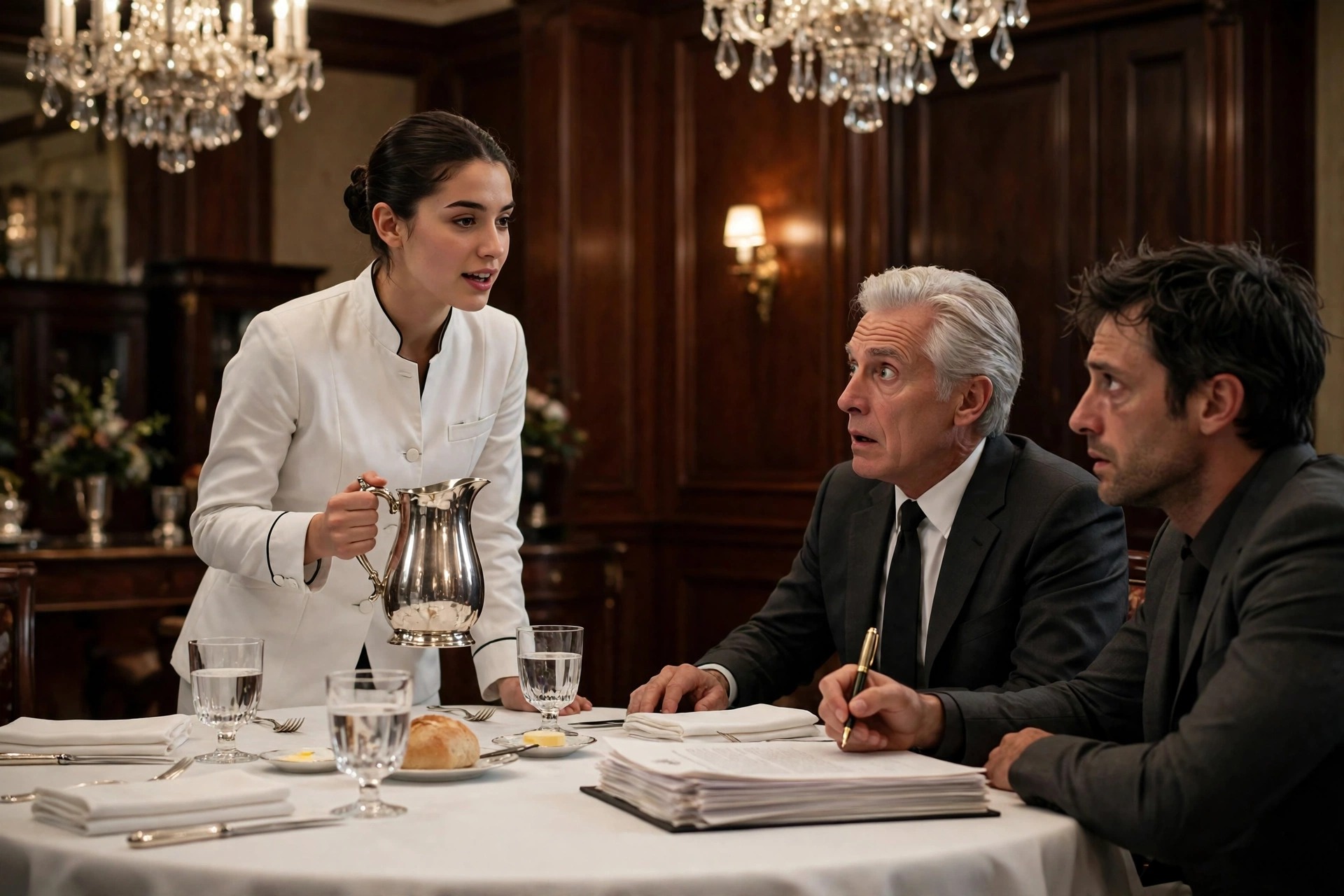
“Get this girl out of my sight,” Mercer snarled, his voice rising enough to turn the heads of a hedge-fund manager and an appellate judge three tables away. “She’s disturbing our guests. She’s completely unhinged. Fire her. Immediately.”
Noah Caldwell did not look at Martin. He didn’t look at Mercer. He rose to his full height—six feet two inches of coiled, athletic tension that suddenly shed its weariness. He placed his left hand flat on top of the contract, dragging it toward his chest.
“Wait,” Noah commanded. The authority in his voice was the same voice that had taken Sentinel Arc from a three-man garage startup to a four-billion-dollar cybersecurity juggernaut.
“Noah, she’s a server having an episode,” Mercer spat, pulling a linen napkin from his lap and tossing it over his plate. “We have eighteen minutes before the midnight wire transfer authorization window closes. If you don't execute the assignment of voting rights now, Crescent Harbor walks. You will be facing an involuntary Chapter 7 liquidation by sunrise.”
Noah looked at Emily. Really looked at her.
He saw the frayed cuff of her shirt, hidden beneath the tailored white house jacket. He saw the cold, crystalline grey of her eyes—eyes that held no madness, only the terrifying, granite stillness of someone who had nothing left to lose.
“What did he say, miss?” Noah asked quietly.
“Mr. Caldwell,” Martin interjected, sweat beading on his upper lip as he grabbed Emily’s upper arm with fingers like iron calipers. “I apologize profusely. Emily, you are terminated. Hand me your apron and step into the manager’s office this instant, or I will have private security drag you to the curb.”
“Take your hand off her,” Noah said.
The tone wasn’t loud. It was deadly.
Martin froze, his hand hovering awkwardly inches from Emily’s sleeve.
Emily didn’t wait for Martin to touch her again. She took two steps back, maintaining her dignity, and addressed Noah directly in English. Her voice was steady, carrying the razor-sharp precision of an academic who had spent her youth breaking down international trade accords.
“Mr. Mercer told you that Mr. Darzi admired your leadership and agreed to keep your engineering team intact,” Emily said, every word hitting the linen tablecloth like lead shot. “That was a fabrication. Mr. Darzi actually asked Mercer why you were fighting so hard when you were already drowning. He called you an emotional American. And Mr. Mercer told him in Arabic that once you sign the 58 percent controlling stake, you will be terminated within forty-eight hours, the proprietary patents will be transferred to a shell company in the Cayman Islands, and the engineering division will be liquidated to clear the balance sheet.”
“You lying little bitch!” Mercer roared, half-rising from his chair.
“And the second breach?” Noah asked, his voice dead, dangerous, and dropping an octave. “What did they say about the second breach?”
Emily looked Mercer dead in the eyes. “Mr. Darzi suggested leaking a fabricated rumor about a secondary data compromise on Sentinel Arc’s core banking firewall tomorrow morning. He said—and I quote—‘It doesn't have to be true. By the time anyone corrects it, the company will be dead.’”
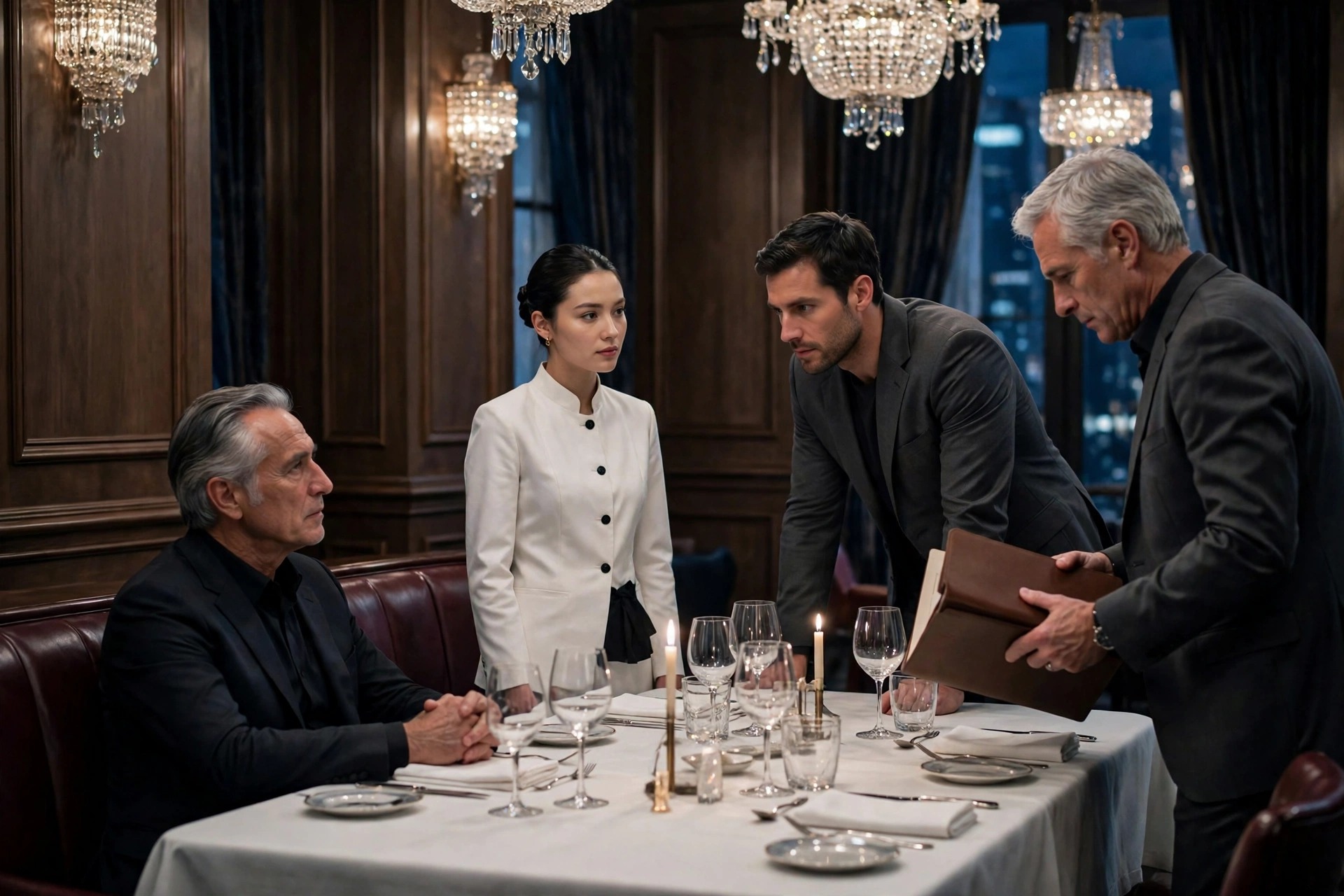
Silence descended over table twelve.
The ambient hum of the Aurelius Room—the murmurs of wealth, the clinking of Riedel crystal, the soft jazz floating from hidden speakers—seemed to die instantly.
Darzi did not look angry. He looked fascinated. He set down his glass, folded his hands over his stomach, and spoke in perfect, Oxford-accented English.
“She translated accurately, Grant.”
Mercer’s neck turned mottled purple. “Nabil, she’s an interloper. You don’t know what you’re doing—”
“I know what I said,” Darzi interrupted smoothly, his voice deep and resonant. He tilted his head toward Emily, inspecting her as if she were a rare, uncataloged artifact. “And more importantly, I know what you told me, Grant. You told me Mr. Caldwell had already agreed to an asset strip. You told me the founder was eager to cash out his remaining twenty million and abandon the platform because he knew Sentinel Arc was fundamentally compromised.”
Noah turned his eyes onto Mercer. The rage that had been simmering under months of exhaustion finally flared into a blinding, arctic flame.
“You set up the short positions,” Noah whispered, the pieces clicking together with terrifying velocity. “You approached my board three weeks ago telling them you had a white knight. You were the one who fed the press the anonymous tip about our server vulnerabilities last month.”
“This is absurd,” Mercer said, though he was already gathering his bespoke leather folio. “This is paranoia from a failing executive who can’t accept that his company is obsolete. Martin, call my car.”
Mercer stood up, buttoning his charcoal suit with jerky, frantic motions. He leaned across the table, his face twisted in venomous spite. “Enjoy the weekend, Noah. Come Monday morning, the market is going to eat you alive. You have no financing, your credit facility is in default, and by nine-thirty AM, you won't even be able to pay the security guards at your own headquarters.”
Mercer turned and marched toward the private elevator foyer, his footsteps heavy and furious.
Darzi remained seated for three seconds longer. He looked at Noah, then at Emily.
“A remarkable young woman, Mr. Caldwell,” Darzi said softly. “You Americans often forget that when you don't speak the language of your partners, you are entirely at the mercy of the translator. Good evening.”
Darzi rose, adjusted his cuffs, and strolled toward the exit with the unhurried elegance of an emperor leaving a minor theater performance.
Martin stood trembling beside the cart, his face pale with dread. “Mr. Caldwell… I am so deeply sorry for this disruption. The meal is, of course, entirely on the house—”
“Get out of here, Martin,” Noah said without looking at him.

Martin vanished like smoke.
Emily felt the adrenaline beginning to retreat, leaving behind a cold, hollow vacuum that threatened to drop her to her knees. Her heart was beating against her ribs like a trapped bird. Her career at the Aurelius Room was over. Her reference was burned to ash. In less than seventy-two hours, the director of Meadowbrook would sign the administrative discharge papers that would move her paralyzed father to a state-run hospice facility in Queens—a place with peeling linoleum and four nurses for eighty patients.
She had traded her father’s life for two minutes of moral superiority.
Emily turned on her heel and walked briskly toward the swinging service doors.
“Wait!”
Noah Caldwell’s voice echoed down the service corridor. Emily pushed through the stainless-steel double doors into the bright, fluorescent glare of the back hallway, where cooks were yelling over sizzling pans and dishwashers were slamming racks of porcelain into industrial steamers.
She didn’t stop. She stripped off her white jacket as she walked, throwing it into the linen hamper. She grabbed her wool coat and her beat-up leather satchel from her locker, slammed the thin tin door shut, and pushed through the emergency stairwell out into the alley behind East 63rd Street.
The autumn rain hit her face like needles.
The cold was shocking, soaking through her thin white blouse before she could even pull the collar of her thrift-store coat together. She stepped out onto the slick sidewalk, her cheap dress shoes skidding slightly on the wet leaves.
“Hey! Stop! Please!”
She turned.
Noah Caldwell had run out into the downpour without an umbrella, without his coat, wearing only his tailored vest and a dress shirt that was already plastered to his chest. His hair was soaked, dripping water into his eyes, but his gaze was locked onto her with a terrifying, incandescent intensity.
“Who are you?” he demanded, catching his breath five feet from her under the amber glow of a streetlamp.
Emily tightened her grip on her bag. Her knuckles were blue from the cold.
“I was your waitress, Mr. Caldwell,” she said, her voice shaking despite her best efforts. “And now I’m unemployed. Leave me alone.”
***
All chapters
- Chapter 1 - The Cold Linen
- Chapter 2 - The Contract in the Rain
- Chapter 3 - The War Room
- Chapter 4 - The Carlyle at 3:00 AM
- Chapter 5 - The Ambush at Wall Street
- Chapter 6 - Shadows on 84th Street
- Chapter 7 - The Midnight Strike
- Chapter 8 - The Boardroom Trap
- Chapter 9 - The Boardroom Massacre
- Chapter 10 - Dawn on the East River
Original source: Chapter 1 - The Cold Linen