
The suburban heat hung thick over the manicured lawn of the Tierrasanta home, smelling of mesquite charcoal, sweet barbecue sauce, and cut Bermuda grass. Eighty people stood frozen, their plastic cups hovering mid-air, their laughter cut short like an engine seizing on dry oil.
Lucas stood with his stainless steel tongs still dangling from his fingers, grease dripping onto the flagstone pavers with a soft, rhythmic hiss. His boyish grin had not entirely faded; it had curdled into something confused, caught between the arrogance of a newly minted shore-duty officer and the sudden terror of a subordinate whose superior had just stepped across an invisible tripwire.
“Sir?” Lucas blinked, his voice pitching higher than he intended. He tried to force a laugh, glancing at the neighbors who had, seconds earlier, been chuckling along with him. “I… I think there’s some kind of mistake. My sister was never in Mosul. She was an administrative contractor for logistics in Kuwait or Qatar or somewhere like that. She never left the green zones. That mark on her neck… it’s a kitchen burn. Dropped a cast-iron skillet when she was twenty-two. We’ve teased her about it for years.”
Commander Jonathan Hayes did not blink. His eyes, the pale gray of an overcast Atlantic morning, remained locked on the star-burst pattern of raised, pale tissue that crept up the left side of my throat.
He took another half-step forward. He was not a tall man, but he carried the density of someone who had spent two decades walking through artillery craters and subterranean bunkers without ever picking up the habit of looking back. When he moved, the entire patio instinctively leaned back, as if clearing a blast radius.
“A cast-iron skillet,” Hayes said softly. The word wasn't an inquiry; it was an autopsy. “A skillet that somehow contained C-4 matrix residue and three-eighths-inch steel ball bearings?”
A murmur rippled through the porch. My mother, Eleanor, stopped dead on the patio threshold with her tray of brioche buns, her fingers digging into the wicker rim until her knuckles went chalk-white. My father, Robert, lowered his can of beer, his brow furrowing in deep discomfort. He hated scenes, but more than that, he hated anything that derailed the trajectory of his son’s golden afternoon.
“Commander,” my father began, stepping down from the wooden deck with the smooth, self-assured stride of a retired district judge. “Let’s not make things awkward for the girl. Brin has always been a little… sensitive about her clumsiness. Lucas was just having some family fun. You know how brothers are.”
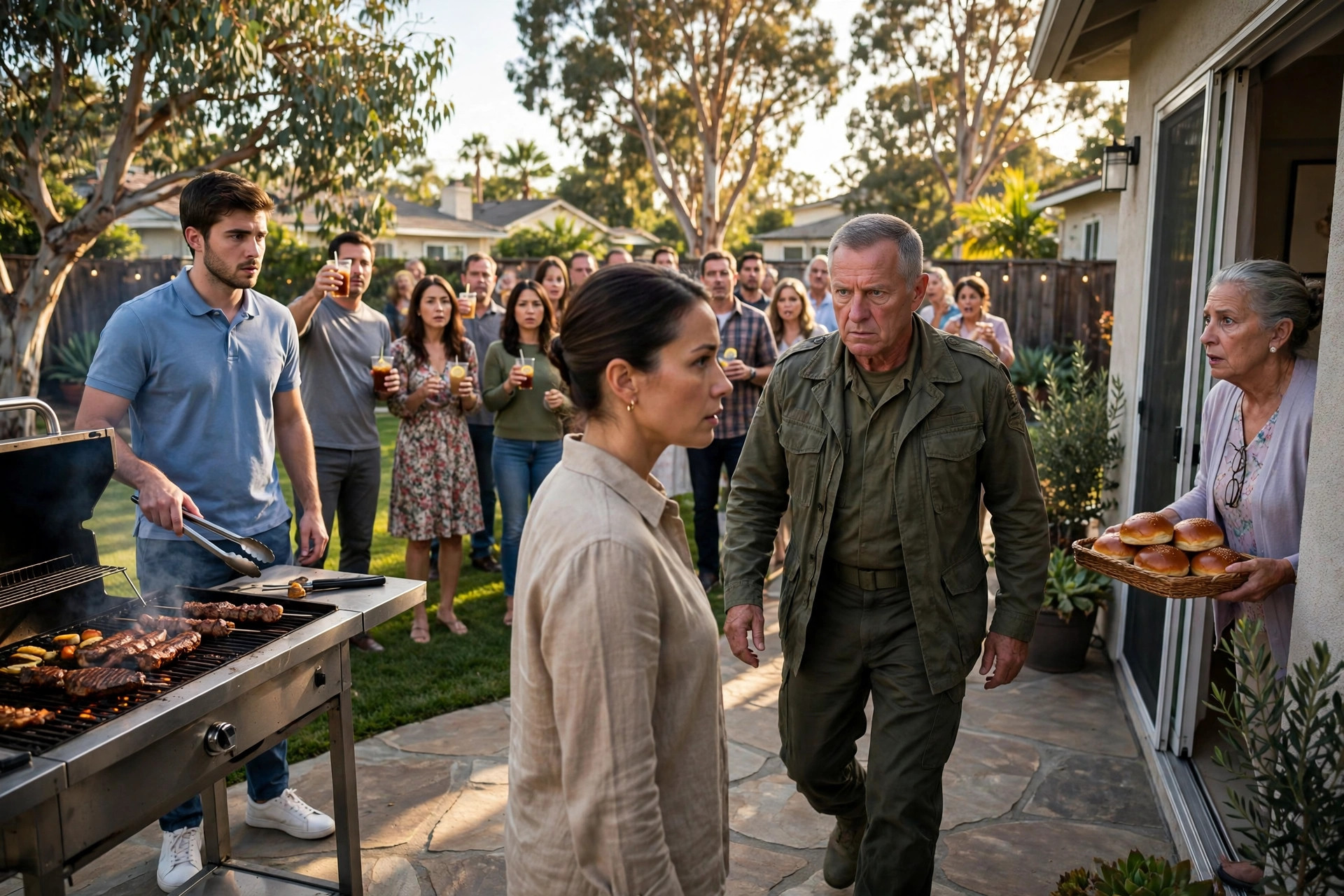
Hayes didn't look at my father. He didn't even turn his head.
“Mr. Vance,” Hayes said, his voice flat and perfectly level, “I spent seven months in Landstuhl and another four at Walter Reed watching plastic surgeons try to graft human tissue over wounds shaped exactly like that. A hot skillet creates an irregular, weeping scalding boundary with uniform dermal depth. It rolls. It blisters.”
He raised one scarred finger, stopping it two inches from the jagged ridge just below my jawline.
“This is an entry point from a directional fragmenting anti-personnel mine. The blast traveled from low to high, roughly thirty degrees off the deck. It caught the ballistic collar of an IBA vest, shredded the Kevlar weave, and deflected upward into the soft tissue beneath the mandible. That starburst isn’t cooked grease. It’s the signature petal pattern of an improvised sleeve designed to hold Russian-made M18A1 copies.”
The yard went utterly, suffocatingly quiet. Even the wind seemed to die in the eucalyptus trees overhead.
Lucas’s mouth opened, then closed. He looked at me, his eyes darting frantically, searching for the submissive, quiet sister who usually slipped into the pantry whenever he started his monologues. He wanted me to save him. He wanted me to nod, laugh self-deprecatingly, and tell this terrifying Navy SEAL that it was all just a wild coincidence so he could get back to his spreadsheets and his promotion photos.
“Brin,” Lucas whispered, his voice trembling with an edge of irritation. “Tell him. Stop playing games.”
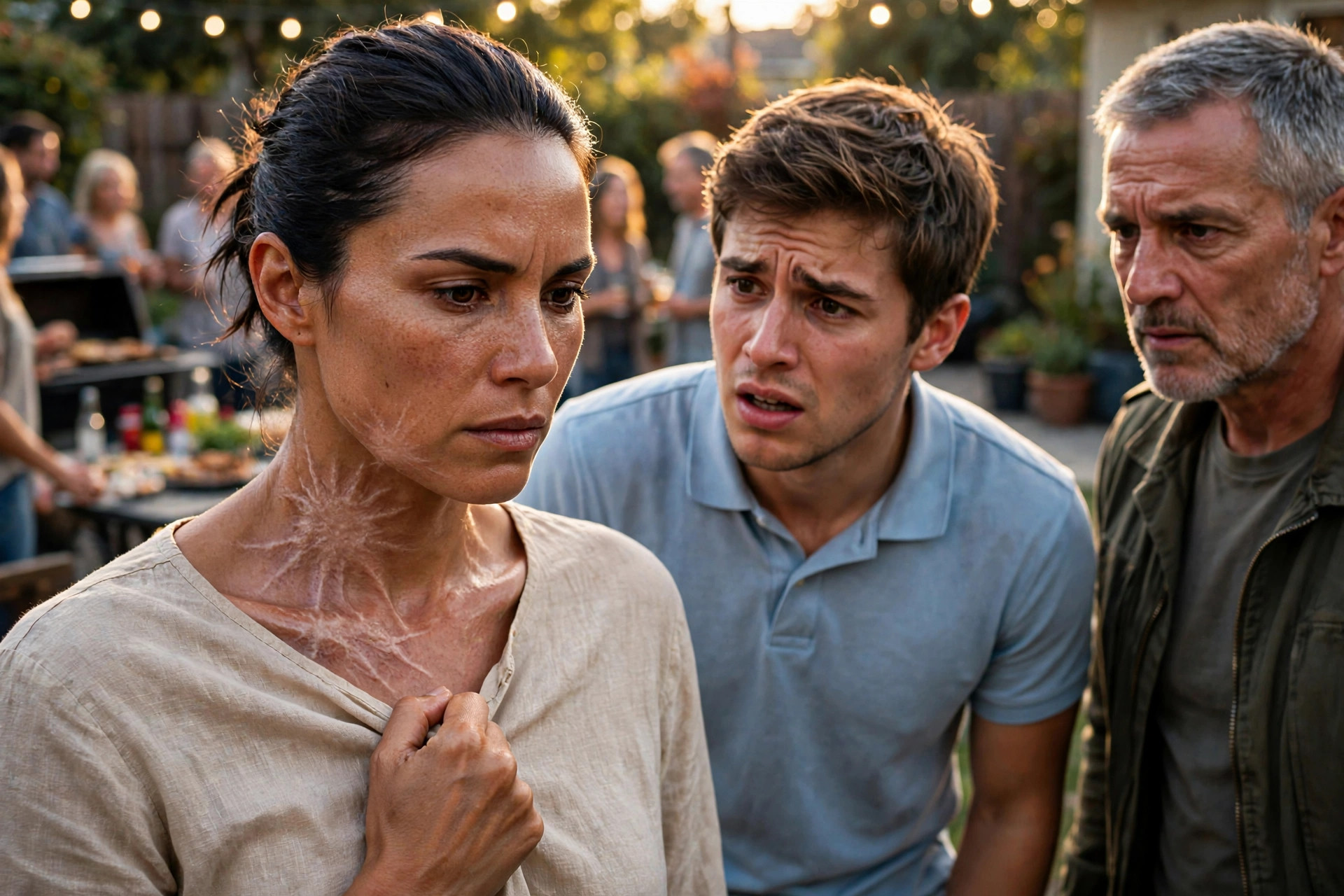
I looked at my brother. I looked at his pressed polo shirt, the pristine white leather sneakers, the manicured fingernails that had never pulled a tourniquet tight enough to hear a teammate scream. For six years, I had listened to him recount his minor administrative triumphs as if they were tactical masterclasses. For six years, I had sat in the corner of this yard, eating cold potato salad, letting them believe I was a failed paper-pusher who had come back from the Middle East with nothing to show but empty pockets and an ugly neck.
I didn't pull my collar up.
For the first time since landing at Lindbergh Field four years ago, I reached up with my right hand, caught the linen fabric, and deliberately pulled it down toward my collarbone.
The full extent of the tissue was exposed to the afternoon sun. The primary starburst branched out into four distinct keloid trails that tracked across my clavicle, vanishing under the strap of my tank top. Beneath the sun-bleached skin, the faint, bluish shadow of trapped lead-antimony dust was clearly visible.
Hayes let out a slow, ragged breath that sounded like it had been trapped in his lungs since the summer of 2019.
“Task Force Blackwood,” Hayes murmured, his gaze lifting from my neck to meet my eyes. “Sector Four, Old City. June fourteenth. Three hours before dawn.”
My chest tightened. The backyard vanished for a split second, replaced by the choking stench of burning trash, powdered masonry, and sulfur. I could hear the wet, hollow thud of mortar rounds walking up the alleyway outside the ruined medical clinic on Nineveh Street.
“Two wounded operators,” I said quietly. My voice was raspy, the vocal cord on the left side permanently nicked by the shrapnel that the field surgeons couldn't extract without risking the carotid artery. “One with a severed femoral artery. One with bilateral compound fractures to the lower legs. You were pinned down behind a half-collapsed mudbrick wall with seven rounds left in your primary.”
A shudder ran through Hayes’s broad shoulders.
“And an unmarked contract logistics handler,” Hayes continued, his voice dropping into a register that made the hairs on Lucas’s arms stand up, “who had no business being on the tactical line, picked up an abandoned PKM machine gun, dumped two hundred rounds into the flanking fire team, and threw herself over our corpsman when the tripwire on the doorway blew.”
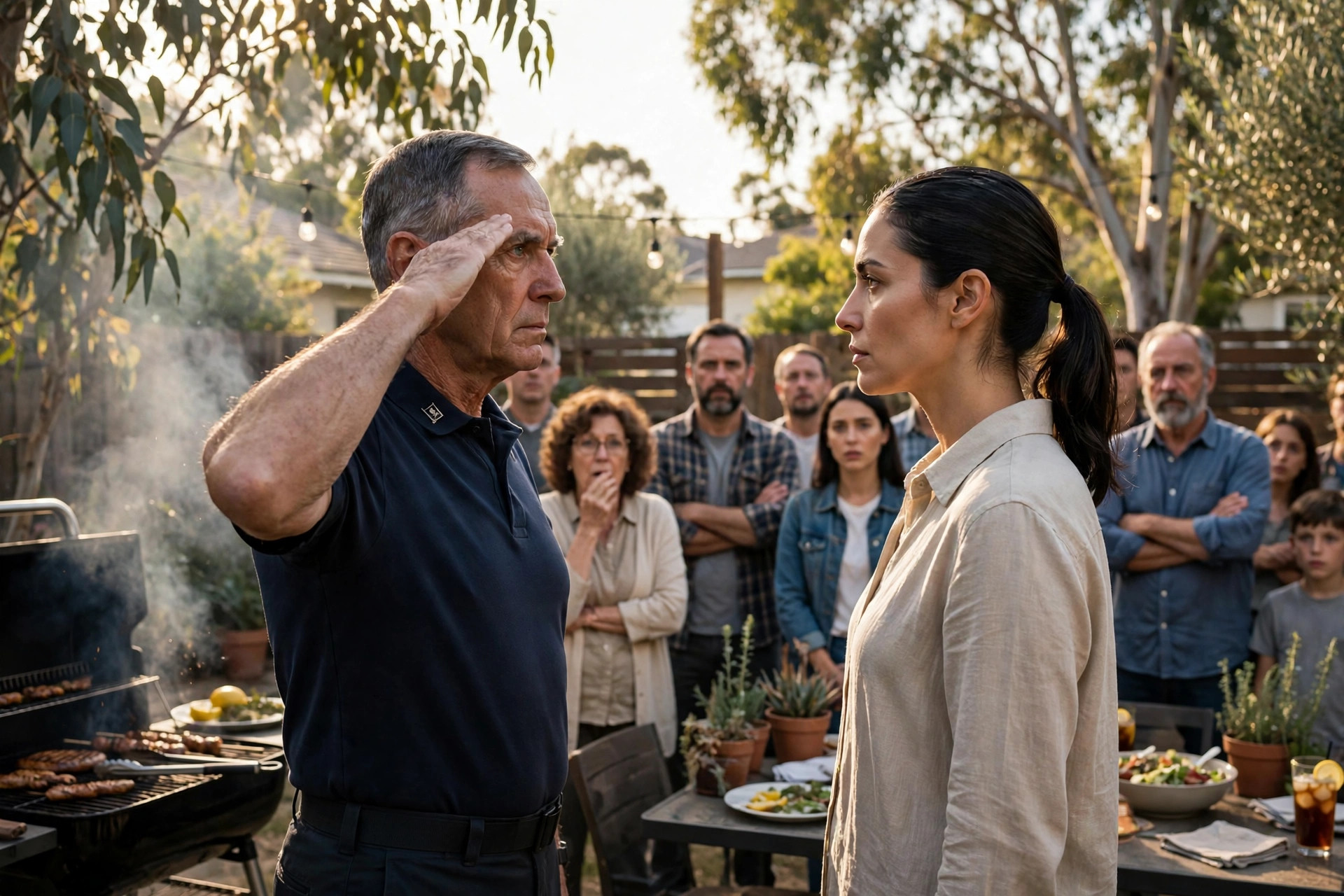
The commander took a slow, deliberate step back and snapped his heels together.
Before eighty neighbors, before my parents, before the junior officers who had come to toast my brother’s safe, easy desk job, the commanding officer of SEAL Team 5 raised his right hand to his temple and rendered a rigid, trembling salute.
“I have looked for you for four years, Specialist.”
All chapters
- Chapter 1 - The Weight of Steel
- Chapter 2 - The Silence of the Courtyard
- Chapter 3 - The Ghost of Old Mosul
- Chapter 4 - The Fractured Deck
- Chapter 5 - The Ghosts on the Line
- Chapter 6 - The Ledger of Coronado
- Chapter 7 - The Call in the Dark
- Chapter 8 - The Paper Trail
- Chapter 9 - The Reckoning
- Chapter 10 - The Salt Air
Original source: Chapter 1 - The Weight of Steel