
Roman Duca did not flinch when I asked what his thirty men did for a living.
The December wind howled down the Philadelphia street, whipping sleet against the rusted corrugated metal of the bus shelter. Old Walter pulled his threadbare blanket tighter around his shoulders, his rheumy eyes darting between Roman’s tailored charcoal overcoat and the two idling black SUVs blocking the curb.
“They protect investments, Miss Sullivan,” Roman answered, his voice smooth as dark bourbon poured over crushed ice. “They resolve disputes. And occasionally, they make very poor decisions that leave them bleeding on my Persian rugs.”
“Gangsters, then,” I said flatly.
Beside him, Vincent—a man whose jawline looked like it had been carved out of granite by an angry sculptor—put a gloved hand inside his lapel.
Roman raised two fingers. Vincent froze instantly, though his glare remained locked on my throat.
“I prefer the term private security logistics,” Roman said. A faint ghost of amusement touched the corner of his lips. “Does that offend your moral sensibilities?”
I looked down at my dead mother’s faded red coat. The cuffs were frayed to gray string. The zipper had caught on the liner three days ago and refused to budge, leaving a draft right against my sternum. In my pocket, my twenty-three dollars felt like Monopoly money against the reality of a winter that was scheduled to drop eight inches of snow by dawn.
“Morals don’t keep frostbite off your toes, Mr. Duca,” I replied, staring directly into his pale slate-gray eyes. “I don’t care if your men steal cars or run for Senate—which, as far as I can tell, requires the exact same skill set. What I care about is whether my paycheck clears on Friday, whether my door has a deadbolt, and whether anyone lays a hand on me.”
“Your paycheck will be direct-deposited or handed to you in cash every Friday afternoon: eighteen hundred a week, tax-free. Your room has an electronic keycard lock that only you and I have access to. And as for the third condition...” Roman took one step closer. He didn't tower over me in a threatening way; he simply occupied space like an oncoming weather front. “Any man in my organization who touches you without your explicit invitation will lose the hand that did it. Then Vincent will take him to the Pine Barrens.”
Vincent didn't blink. He just gave a tiny, grim nod that confirmed the Pine Barrens were not a vacation destination.
I turned back to Walter. The old man was shivering, his lips faintly blue.
“I have a condition of my own,” I said.
Roman tilted his head. “You haven’t accepted the job yet, and you’re already negotiating?”
“Take Walter to St. Agnes Shelter. Pay their private donor intake fee so he gets a private room, clean sheets, and three hot meals a day through March. Do that right now, in front of me, and I’ll get in your car.”
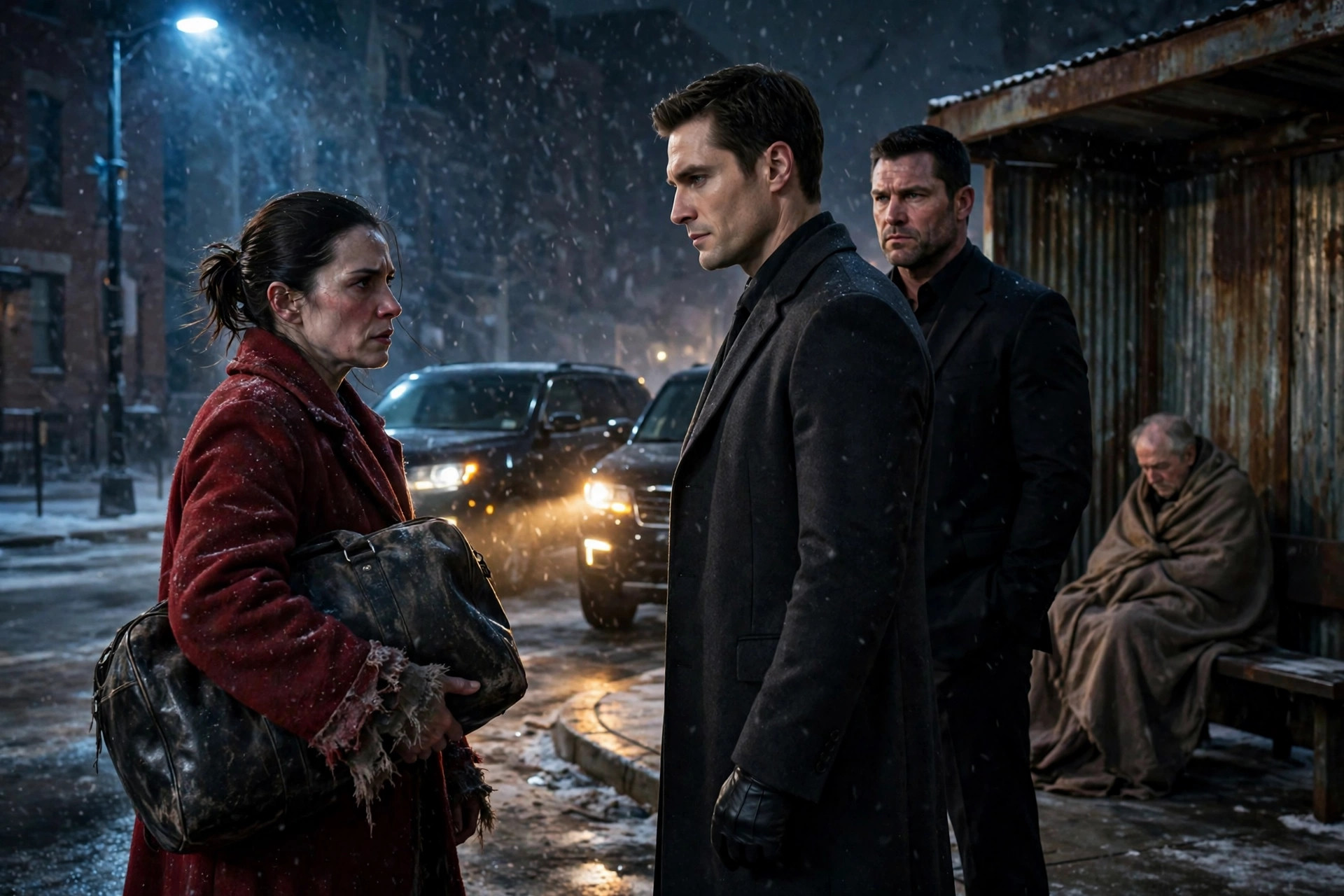
Silence fell over the corner of 8th and Market. A city bus rumbled past, throwing a spray of slush that Roman didn't even bother flinching away from.
Vincent scoffed under his breath. “Boss, we don’t have time for—”
“Vincent,” Roman murmured softly.
The bodyguard cut off mid-sentence.
Roman reached into his breast pocket, pulled out an embossed leather cardholder, and extracted a sleek black card. He handed it to Vincent without taking his eyes off mine.
“Call Father Thomas at St. Agnes. Tell him the Duca Foundation is sponsoring Mr. Briggs for the winter wing. Private suite. Full medical evaluation by morning.” Roman paused, his gaze lingering on the stubborn set of my jaw. “And put ten thousand into their general kitchen fund while you’re on the phone.”
Walter’s breath hitched. A tear cut a clean gray line through the grime on his cheek. “Maggie... girl, you don’t gotta do this for an old bum.”
“You shared your coffee with me on Tuesday, Walter,” I whispered, squeezing his trembling, frost-stiffened fingers. “Eat the hot food. Don't argue with the nuns.”
Ten minutes later, Walter was being helped into the second SUV by a surprisingly gentle driver, and I was sitting in the butter-soft leather back seat of Roman Duca’s customized Cadillac Escalade.
The heat hit me first. It poured out of the vents like molten honey, sinking into my chilled bones until my fingers began to throb with the agonizing pins-and-needles of thawing nerves. I gripped the handles of my scuffed vinyl duffel bag on my lap, refusing to lean back into the leather.
Roman sat across from me, his long legs angled slightly to avoid brushing my knees. The interior smelled of expensive tobacco, cedarwood, and old paper.
“You’re thirty-four,” Roman observed as the SUV glided through the snow-slicked streets toward the expressway. “No husband. No children. Your last address was a foreclosed split-level in Upper Darby six months ago. Before that, twelve years running industrial food services for Keystone Foundry.”
I stiffened. “You ran a background check in the six minutes Vincent was on the phone?”
“I don't invite people into my home without knowing their history, Maggie.”
“Then you know my mother spent three years dying of small-cell lung carcinoma,” I said, my voice hardening to sheet metal. “You know her medical bills ate the house, the pension, the savings, and the cemetery plot. And you know when Keystone Foundry shut its doors in September to move manufacturing to Monterrey, they gave two hundred employees three days of severance and a middle finger.”
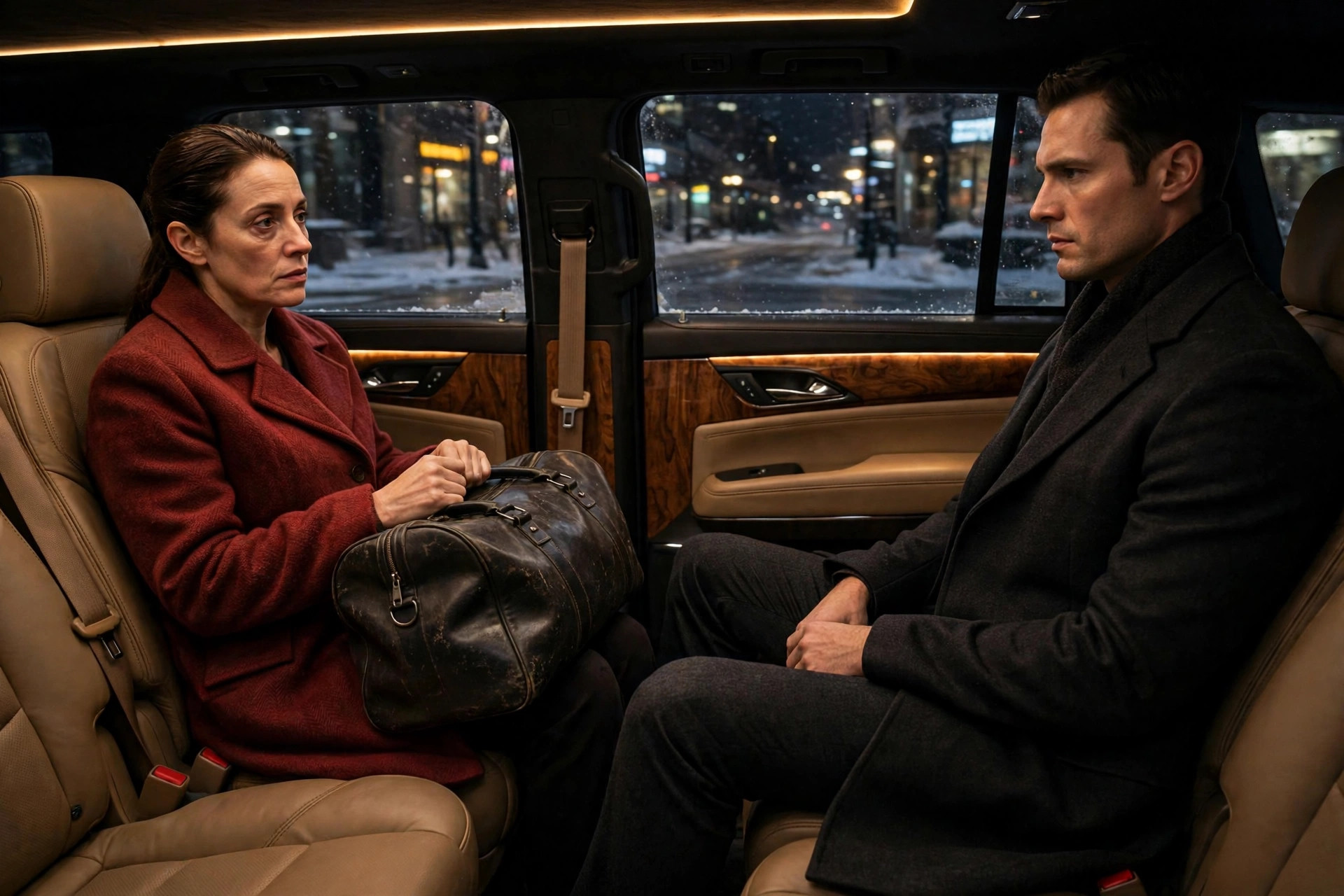
“I know,” he said quietly.
“Then don't look at me like I’m a charity case, Mr. Duca. I don't need pity. I need a kitchen, a wholesale food vendor with reliable produce, and an industrial dishwasher that doesn't blow fuses.”
For the first time that night, the cold mask of Roman Duca cracked. His lips parted in a genuine, razor-sharp smile that transformed his severe features into something dangerously magnetic.
“Fair enough,” he said. “Let’s see if your cooking is as sharp as your mouth.”
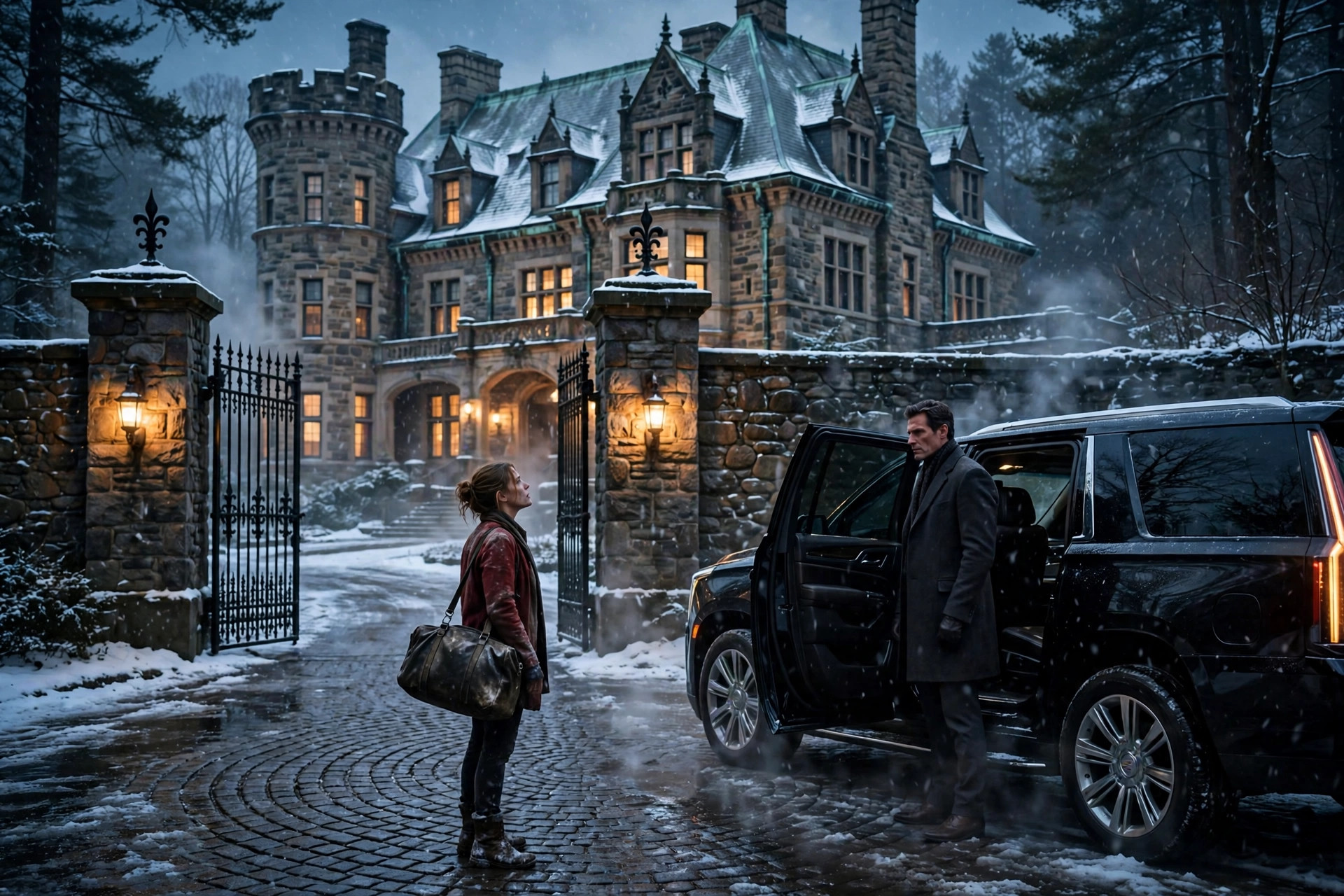
We drove forty minutes west, leaving the city lights behind for the winding, tree-choked hills of Chester County. The roads narrowed, surrounded by dense stands of black walnut and hemlock heavy with fresh snow. We passed through a set of wrought-iron gates eighteen feet tall, topped with sharp fleur-de-lis spikes and monitored by infrared cameras that pivoted to track our approach.
Ravenwood Estate didn't look like a suburban McMansion. It looked like a nineteenth-century fortress built by a baron who expected a siege.
Fieldstone walls three feet thick rose against the winter sky, illuminated by warm copper sconces. Slate roofs, copper gutters, and bullet-resistant double-paned windows glowed against the dark woods. As the SUV pulled up the heated circular cobblestone driveway, four men in heavy tactical parkas emerged from the perimeter shadows, their hands resting comfortably near the holsters under their arms.
They saw Roman through the tinted glass and snapped into crisp nods of deference.
Roman opened his door and stepped out, then turned to offer me a gloved hand.
I ignored it, hauled my battered duffel over my shoulder, and stepped onto the warm pavers under my own power.
“Inside,” Roman commanded softly. “The kitchen is through the west wing. I’ll show you your quarters first.”
The foyer took what little breath I had left. A sweeping dual staircase of dark oak flanked a massive crystal chandelier that looked like an inverted waterfall of ice. Marble floors reflected the amber light. But beneath the elegance, there was a palpable undercurrent of violence: the faint smell of gun oil beneath lemon oil polish, the subtle bulge of Kevlar beneath the suits of three men standing near the library entrance, the absolute silence that fell over the house the second Roman crossed the threshold.
“Boss,” one of the men said—a younger guy with a scar running through his left eyebrow. “Cardone called twice from South Philly. He wants to know about the shipment at Pier 40.”
“Tell Cardone if he calls this house after midnight again, I’ll have Vincent explain the concept of office hours to him with a tire iron,” Roman replied without breaking stride.
The scarred man blinked, swallowed hard, and stepped back. “Understood.”
Roman led me down a wide, stone-floored corridor lined with oil paintings of stormy seas and forgotten battles. At the end of the hall, he pushed open a heavy oak door to reveal a bedroom larger than the entire ground floor of my mother’s house.
It had a king-sized four-poster bed with an ivory duvet, an electric fireplace already crackling against the wall, a walk-in closet, and an en-suite bathroom with a clawfoot soaking tub that made my aching joints weep with envy.
“The keycard is on the desk,” Roman said, leaning against the doorframe. “Bathroom has clean towels. The closet has several sets of chef’s whites and comfortable clothes Vincent’s people picked up from an all-night department store. If they don’t fit, leave them outside the door.”
I set my duffel down on the rug. The contrast between my threadbare belongings and this palace was almost grotesque.
“Breakfast is at seven,” Roman said. “Thirty men. They train at six, they shoot at six-thirty, and by seven they eat like starved wolves. Can you do it alone, or do you need me to call in temp prep staff?”
I turned around, meeting his gaze.
“I managed seventy-five hungover metal casters who hadn't seen a green vegetable in three decades, Mr. Duca. Your thirty trigger-happy babysitters aren't going to scare me. Just make sure the pantry is stocked.”
“The pantry is yours,” he said softly.
He stood there for a beat longer than necessary, his dark eyes tracing the tired hollows beneath my cheekbones, the tension in my shoulders, and the defensive tilt of my chin. Something shifted in the air between us—a current of heat that had nothing to do with the roaring fireplace.
“Get some sleep, Maggie,” he murmured, then pulled the door shut behind him.
I didn't sleep right away. I stood in the middle of that vast, quiet room for five full minutes, listening to the heavy thud of the electronic lock engaging.
Then I ran the hottest bath of my entire life, scrubbed three weeks of street grime and desperation from my skin, and laid down on sheets that felt like cloud cover.
For the first time in six months, I didn't wake up shivering.
***
All chapters
- Chapter 1 - The Gates of Ravenwood
- Chapter 2 - The Steel Ladle Incident
- Chapter 3 - Blood on the Granite
- Chapter 4 - The Ledger and the Scars
- Chapter 5 - Whispers in the Pantry
- Chapter 6 - The Poison in the Well
- Chapter 7 - When the Wolves Circle
- Chapter 8 - The Siege of Ravenwood
- Chapter 9 - The Price of Family
- Chapter 10 - A Ravenwood Christmas
- Chapter 11 - Shadows in the Snow
- Chapter 12 - The Wolf at the Table
- Chapter 13 - The Drake Hotel
- Chapter 14 - Blood on the Snow
- Chapter 15 - The Scars We Share
- Chapter 16 - The Council of Ash
- Chapter 17 - The Hostage at the Altar
- Chapter 18 - The Trap Springs
- Chapter 19 - The Wrath of Ravenwood
- Chapter 20 - The Vow and the Knock
- Chapter 21 - The Ghost of Manhattan
- Chapter 22 - Bloodline and Black Roses
- Chapter 23 - The Shadow Over the Cathedral
- Chapter 24 - The Costello Decree
- Chapter 25 - The Sins of the Fathers
- Chapter 26 - Iron and Silk
- Chapter 27 - The Ambush at Michigan Avenue
- Chapter 28 - Vengeance in White
- Chapter 29 - The Crown of Chicago
- Chapter 30 - The Sovereign’s Gambit
Original source: Chapter 1 - The Gates of Ravenwood