
“How terrible?” Roman asked again, his fingers resting motionless beside his silver fork.
Emma let out a breath that sounded like dry leaves scraping pavement. “Like leather left on a radiator. She used to baste it with ginger ale because someone in a laundromat told her the carbonation broke down the fibers. It didn't. It just made the skin stick to the roasting tin like melted cellophane. But she bought paper hats from the dollar store, and we wore them until the elastic snapped against our chins.”
Roman didn't smile, but the hard, carved lines around his eyes softened by a fraction of a millimeter. “And the rolls?”
“Charred black on the bottom, raw dough in the middle. We called them lava cakes.” Emma looked down at her plate, suddenly aware of how clean she had scraped the white porcelain. The cranberry sauce had left a faint ruby smear across the rim. “I don't know why I'm telling you this. You probably had caterers in tuxedos carving heritage birds flown in from Vermont.”
“I grew up in an apartment on Twenty-Fourth and California,” Roman said quietly. “My mother died when I was seven. My father worked thirty-hour turnarounds at the railyards and bought fried chicken from a gas station on Western Avenue because the grease kept the foil bag warm until he walked home. If he was sober enough to sit at the table, we called it a holiday.”
Emma raised her chin, studying him. The tailored charcoal wool of his coat hung over the back of chair eleven. His cuffs were white, crisp, fastened with plain silver links that carried no gaudy monograms. Everything about him suggested money that didn't need to shout, yet his voice carried the low, flattened cadence of the South Side—the sound of people who learned early that raising their voices only brought fists or landlords down on their heads.
“You don't talk like someone who bought gas station chicken,” she said.
“I learned another language when I needed to buy banks,” Roman replied. “That doesn't change where the accent came from.”
Silence settled between them again, but the draftiness of Harbor & Ash had receded. Outside the floor-to-ceiling windows, the snow had thickened into heavy, wet flakes that gathered on the iron railings of Grand Avenue. The city was shutting down. A lone yellow cab drifted past, its tires hissing through the slush.
In the back office, the floorboards creaked. Pete poked his head out, his coat already zipped to his chin, a knit scarf tucked into his collar. He looked at Emma, then at Roman, his eyes darting like a minnow in shallow water.
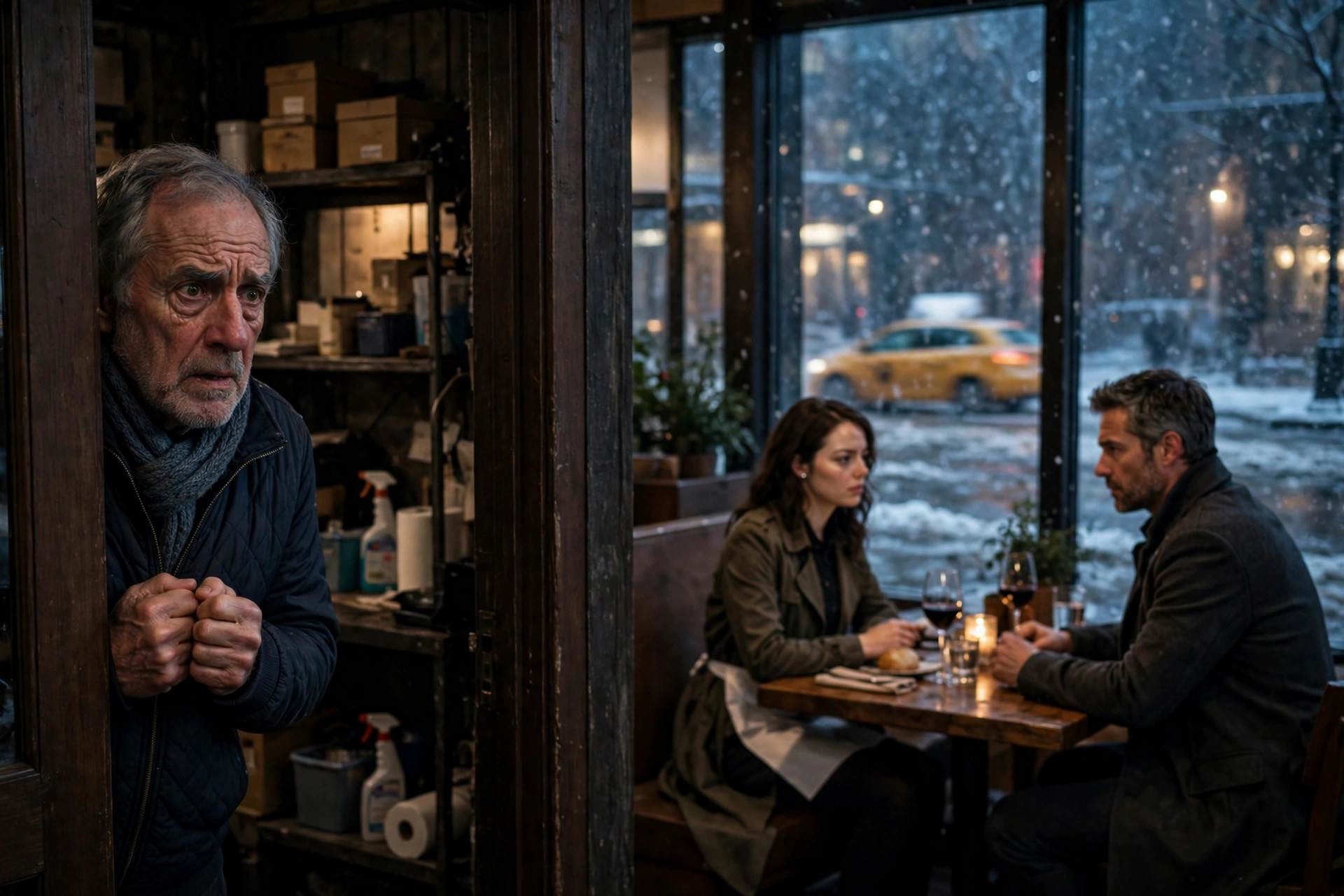
“Mr. Vale,” Pete stammered, wringing his hands. “I’ve locked the liquor cages and set the perimeter alarm for the rear alley. If you... if you need anything else...”
“Take your car, Pete,” Roman said without turning his head. “Do not speed over the bridge; the city hasn't salted the metal grating yet.”
“Yes, sir. Thank you, Mr. Vale. Goodnight, Emma.” Pete didn't wait for a response. He slipped through the heavy front door, the brass bell ringing once, shrill and brief, before the latch clicked shut.
Emma set her cloth napkin on the table. “You terrify him.”
“Pete owes sixty-two thousand dollars to men who do not offer Thanksgiving dinner,” Roman said evenly. “He is terrified because he assumes everyone with a bank account operates with an iron bar.”
Emma’s heart took a strange, jagged bounce against her ribs. “And you don't?”
Roman picked up his bourbon, swirled the dark amber liquid against the heavy base of the glass, and set it back down without taking a sip. “An iron bar is an inefficient way to collect a balance. It ruins the debtor’s ability to work.”
“That’s not a denial.”
“It’s an explanation of economics.” Roman stood up.
He was taller than he seemed when seated—broad through the shoulders, his spine straight with the rigid, unyielding posture of a soldier or a man who had spent decades refusing to duck. He reached for his overcoat, shook the faint smell of tobacco and winter wool from the fabric, and draped it over his forearm.
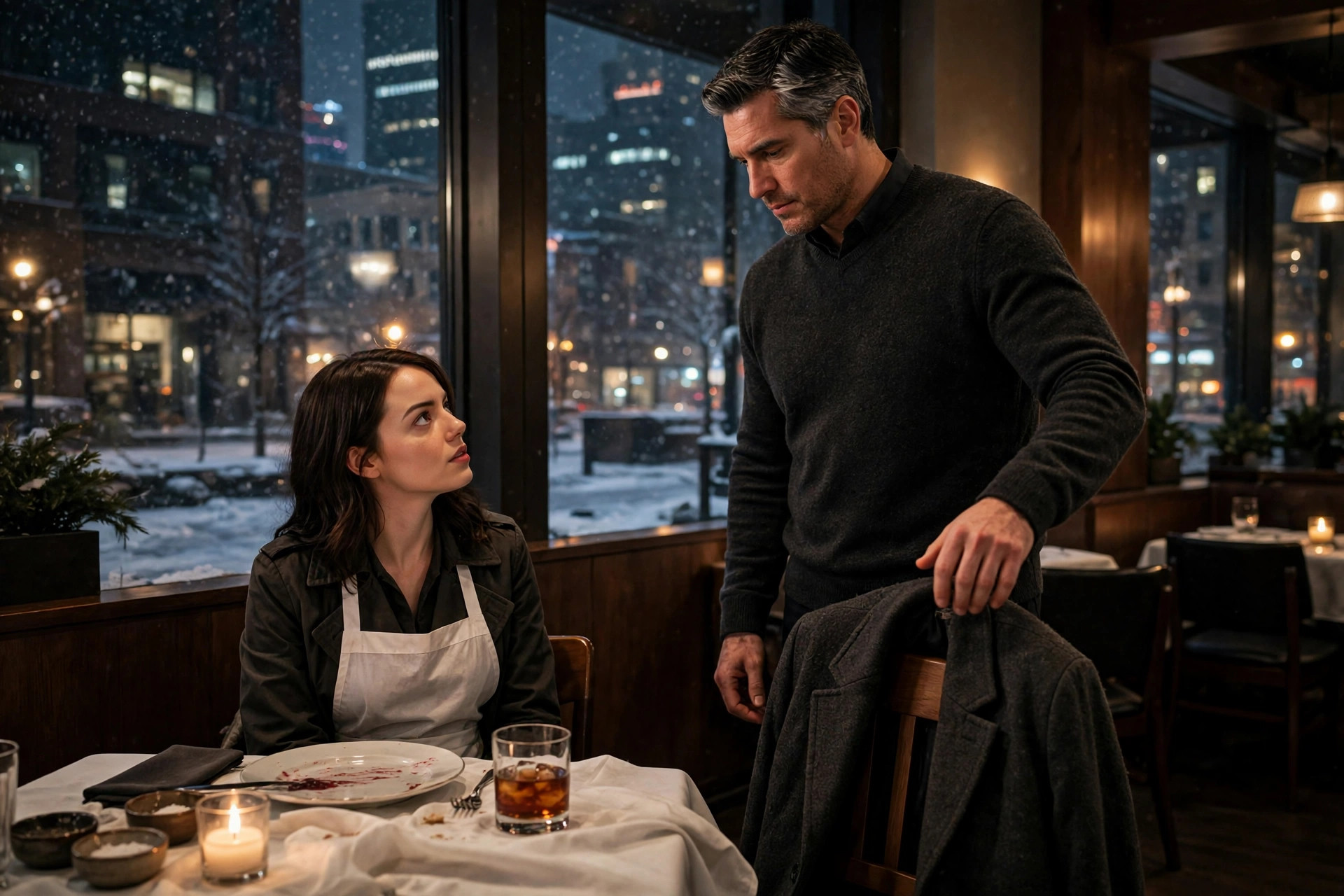
“Put your coat on, Emma.”
Her defenses flared instantly, the protective shell she had worn like armor since nineteen snapping into place. “I told you, I live twenty minutes away. I can take the Red Line.”
“The Red Line at ten o'clock on Thanksgiving night is currently inhabited by three transit officers who are sleeping in their booths and six people who have spent twelve hours drinking mouthwash behind the Grand station,” Roman said, his tone matter-of-fact, void of condescension. “You have eighteen dollars in tips in your apron and wet canvas shoes. You are not riding the train.”
Emma stared at him, her jaw tight. “You’ve been watching my shoes?”
“I notice when people who work eight hours on concrete walk with a limp on their right heel.” He paused, looking directly into her eyes. His gaze was slate-gray, steady, and uncomfortably penetrating. “Get your coat. Or I will have Miller carry it out for you.”
“Is Miller the one who looks like an ex-linebacker or the one who looks like he buries things for fun?”
A phantom twitch touched the corner of Roman’s mouth. “Both descriptions apply to Miller. The other one is Thomas. Thomas is worse.”
Five minutes later, Emma found herself pushed through the heavy glass doors into the biting Chicago freeze. The cold hit her face like a slap of wet silk. At the curb, the massive black SUV rumbled, its exhaust billowing into the snowy dark like white steam from a locomotive. The man Roman had referred to as Miller—broad-jawed, with a nose that had clearly been broken twice and mended without surgery—stepped forward instantly, holding the rear passenger door wide.
“Sir,” Miller murmured, his breath clouding.
“Miller,” Roman said. “Take Miss Callahan to her building. North Hermitage.”
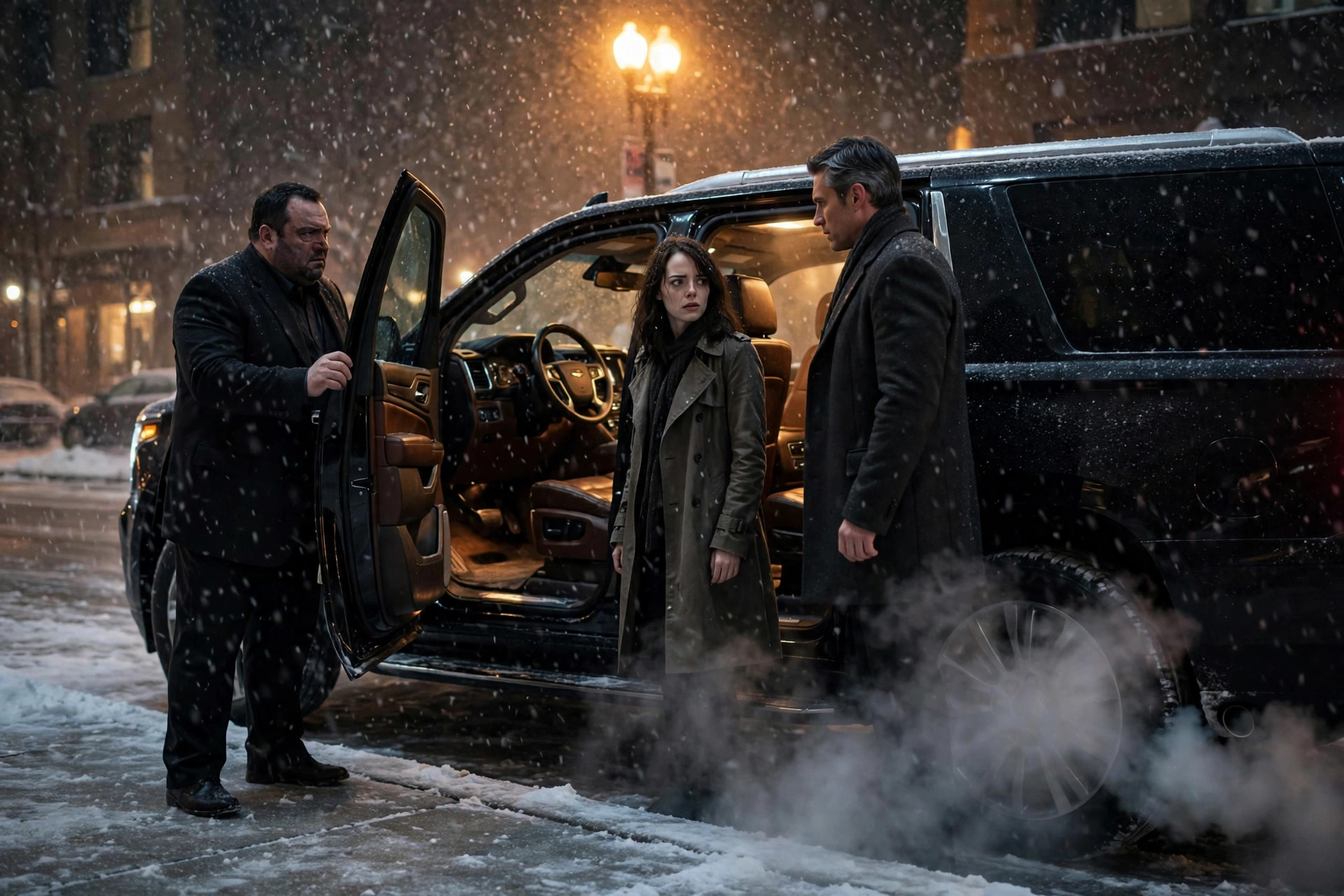
Emma stopped dead on the icy concrete. The wind whipped a strand of dark brown hair across her mouth. “I didn't tell you my street.”
Roman paused beside the door. The amber streetlight caught the silver at his temples, the clean edge of his jaw, and the absolute lack of apology in his expression.
“You applied for a city server permit three months ago,” Roman said, his voice quiet against the howl of the wind down Grand Avenue. “Harbor & Ash is located within a district whose commercial leases fall under my office. When an employee handles the cash and closing locks of my tenants, I know who they are. Your rent is eight hundred and fifty dollars. You are seventeen days late. And your landlord, Mr. Geller, is an unpleasant man who turns off the radiator valves in the basement when the temperature drops below twenty.”
Emma felt the blood leave her face, replaced by a sudden, hot wave of anger that overwhelmed her fear. “You checked my credit? You had someone look into my apartment?”
“I had someone ensure that the girl who spent eight months serving my coffee without spilling a drop wasn't going to freeze to death because an idiot named Geller wanted to save four hundred dollars on heating oil.” Roman gestured toward the open seat, the leather interior glowing with soft footwell illumination. “Get in the car, Emma. It’s twelve degrees.”
“I don't want your charity, Mr. Vale.”
“Good,” Roman replied, stepping closer until she had to tilt her head back to hold his gaze. The heat coming off him was real, contrasting sharply with the freezing air. “Charity is given to make the giver feel virtuous. I have never claimed to be virtuous. Get in.”
She wanted to run. She wanted to throw her tips in his face and walk until her sneakers froze to the slush on State Street. But her toes were already numb, the wind was cutting through her thin trench coat, and the solid, terrifying reality of Roman Vale was the only warm thing within five miles.
Biting her tongue until she tasted copper, Emma Callahan climbed into the back of the black SUV.
All chapters
- Chapter 1 - The Weight of an Open Door
- Chapter 2 - The Red Lining
- Chapter 3 - Blood on the Linoleum
- Chapter 4 - The Architecture of Wolves
- Chapter 5 - A Fire in the Snow
- Chapter 6 - The Iron Threshold
- Chapter 7 - Salt and Shards
- Chapter 8 - A City Under Ice
- Chapter 9 - The Glass Cathedral
- Chapter 10 - The First Cold Sun
- Chapter 11 - The Salt on Clark Street
- Chapter 12 - The Salt on the Marble
- Chapter 13 - The Iron Cage
- Chapter 14 - The Weight of Gold
- Chapter 15 - The Salt on Table Twelve
- Chapter 16 - The Blueprint of Ashes
- Chapter 17 - The Train That Didn't Leave
- Chapter 18 - The Palm Court
- Chapter 19 - The Hearth and the Hammer
- Chapter 20 - The First Reservation
Original source: Chapter 1 - The Weight of an Open Door