
The clinking of Jessica’s wine glass against the dining table echoed like a gunshot in the sudden, dead quiet of the room. The dark red liquid seeped deep into Jacob’s cheap watercolor paper, drowning the fragile horizon he had worked on for three days. My six-year-old boy remained frozen, his little shoulders hunched inward, his head bowed so low his nose nearly brushed the crimson pool. He didn’t make a sound. He had learned early that in this family, crying was simply considered an invitation for further cruelty.
Uncle Mark was still chuckling, reaching for another dinner roll, while my mother, Susan, hurried over with a handful of paper towels. But she didn’t look at Jacob. She didn’t look at the trembling lower lip he was biting until it turned white. She rushed past him to blot the edge of the antique oak table.
“Jessica, honey, be careful,” Susan scolded mildly, her voice dripping with artificial sweetness. “This table was imported from France. If the varnish stains, your father will have a fit.”
“He won’t care, Mom,” Jessica scoffed, leaning back and admiring her manicured nails. “It’s just an old piece of wood. Besides, the table’s useful. That little doodle was just trash cluttering up family space. Jacob has to learn that real life doesn’t hand out gold stars for finger painting.”
My breath caught in my throat. The hot, metallic taste of fury surged under my tongue. For six years, I had swallowed their passive-aggressive remarks, their snide comparisons between my modest life as a freelance graphic designer and Jessica’s glamorous, trust-fund-subsidized lifestyle. I had endured it all to keep the peace, to give Jacob a grandfather he adored. But watching my little boy shrink into himself, trying to become invisible to survive the mockery of grown adults, something inside me snapped cleanly in two.
Before I could lunge across the table, a heavy sound cut through the cabin air.
It was a slow, deliberate scrape of a wooden chair against the floorboards.
At the head of the table, my father, David, stood up.
David was sixty-two years old, a structural engineer who had spent four decades designing suspension bridges and commercial skyscrapers. He was a man of few words, built like an iron pillar—broad-shouldered, silver-haired, with piercing slate-gray eyes that usually missed nothing and revealed even less. For the entire afternoon, he had sat quietly at the head of the table, reviewing structural blueprints for a regional civic center, barely taking part in the petty chatter.
Now, he towered over the table. The air in the room instantly dropped several degrees.
Uncle Mark’s chuckle died in his throat. Susan froze, paper towels clutched in her hands, her eyes darting nervously to her husband. “David? What is it, dear? I’m cleaning it up right now—”
David didn’t answer her. He didn’t look at Susan, nor did he look at Jessica, who was already rolling her eyes, assuming our father was simply annoyed by the mess.
Instead, David looked down at Jacob. His gaze softened for a fraction of a second, resting on the boy’s trembling hands and the discarded paintbrush still dripping blue onto the soaked paper.
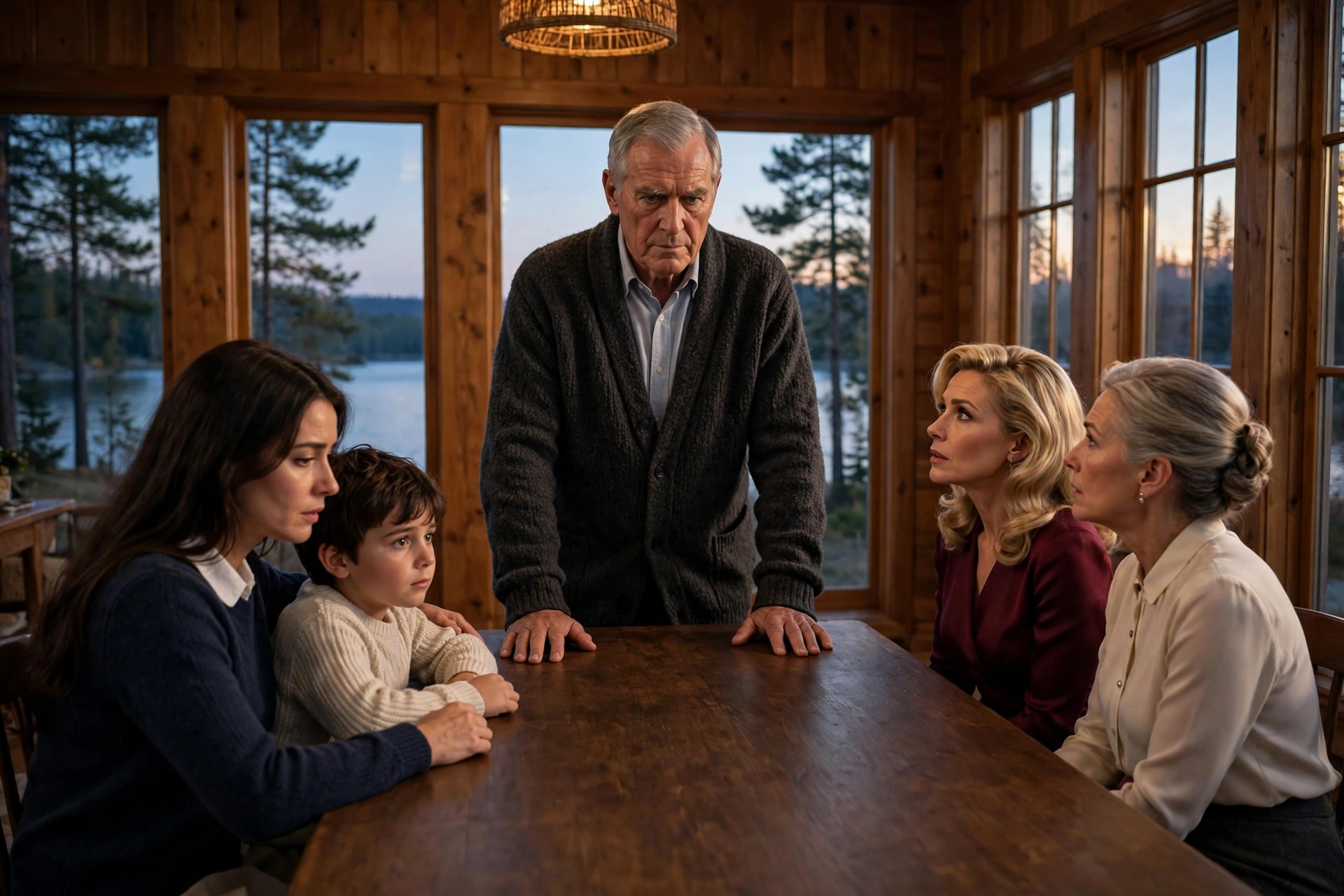
Then, David raised his left hand.
Slowly, methodically, he used his right thumb and forefinger to grasp the heavy gold band on his ring finger. It was the wedding band he had worn for thirty-four years, through Susan’s endless social ambitions, through decades of quietly funding Jessica’s failed vanity businesses, through every miserable family gathering where cruelty was masked as humor.
He pulled the ring off.
Susan gasped, her voice shrill. “David! What are you doing?”
David didn't blink. He extended his hand over the center of the table, right above the ruined painting. Then, he opened his fingers.
*Plink.*
The gold ring hit the glass Jessica had turned upside down, bounced off the rim, and landed squarely in the center of the dark red puddle, sinking into the sodden watercolor paper right between Jacob’s drowned sun and ruined lake.
Jessica frowned, her arrogance faltering. “Dad? What is your problem? It was just an accident, and honestly, the kid was being annoying—”
“Shut up, Jessica,” David said.
The words were not shouted. They were delivered with the flat, absolute finality of an iron gate slamming shut. Jessica snapped her mouth closed, her eyes flashing with indignant shock. In thirty-three years, our father had never once told her to shut up.
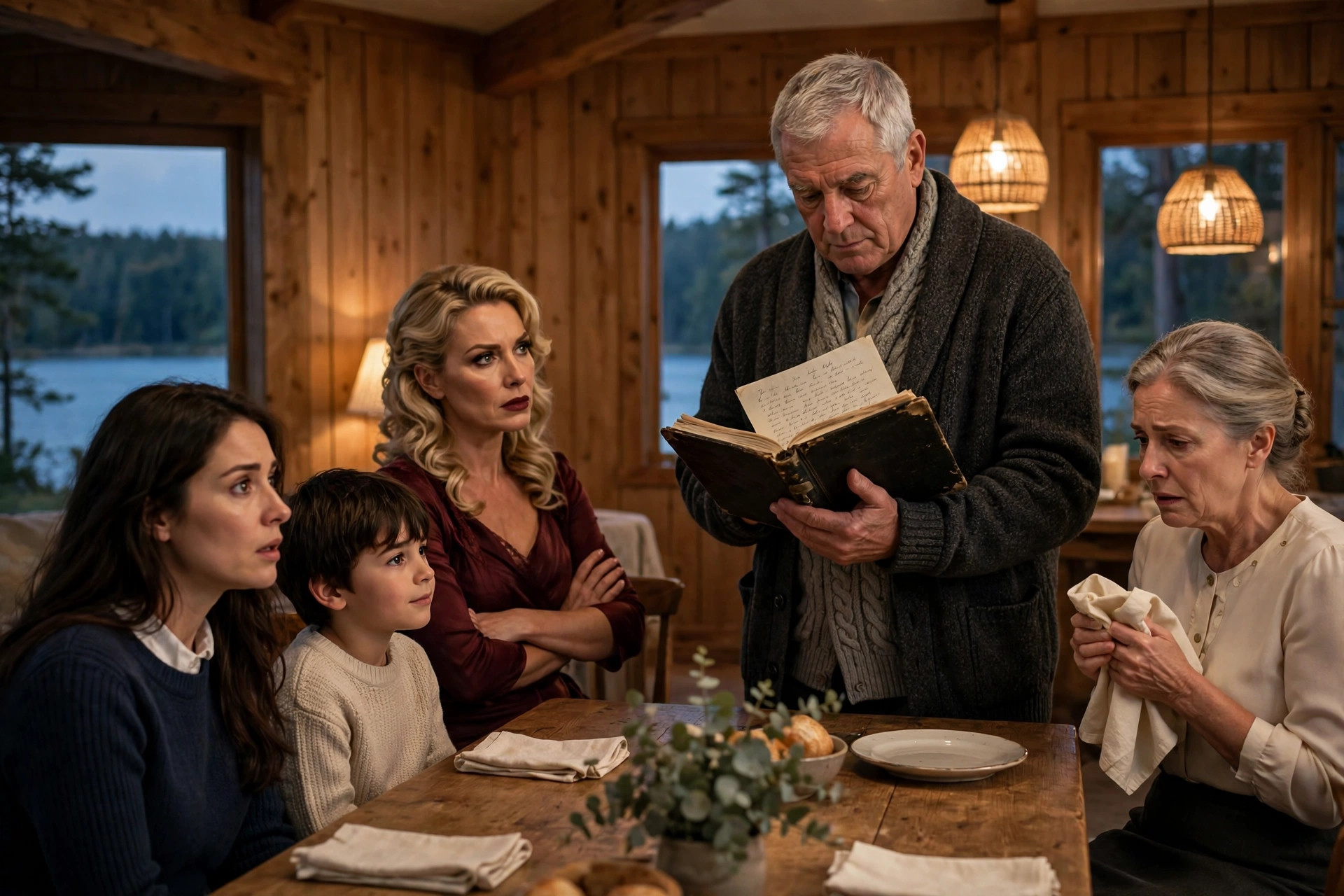
David reached into the inner breast pocket of his heavy wool cardigan. He pulled out a worn, black leather-bound notebook. It was thick, fastened with a tarnished brass clasp, its edges scuffed by years of handling. None of us had ever seen it before.
He unfastened the brass clasp with a soft *click*.
“David,” Susan stammered, stepping away from the table, her face losing its color. “David, please. Don’t do this in front of company. Mark and Linda are here, the children are here—”
“There is only one child at this table,” David said, his voice terrifyingly calm. “And he is the only person in this room who came here with an honest heart.”
David turned a page in the notebook. His eyes scanned the neat, handwritten columns—dates, figures, account numbers, and legal citations. As a structural engineer, David kept logs of stress tolerances, load-bearing capacities, and material failure points. For decades, he had applied that exact same discipline to his family.
“For twenty years,” David said, looking up, his gaze fixing upon Jessica, “I have watched you treat people as if they were disposable objects placed on earth for your amusement. When you were sixteen, you backed your car into the neighbor’s fence and blamed your sister Clara. When you were twenty-two, you ran through your college fund in three semesters on designer clothes and demanded Clara surrender her savings so you wouldn't be embarrassed in front of your sorority sisters.”
Jessica scoffed, trying to regain her footing. “Are you seriously bringing up ancient history because of some stupid paint? Dad, you’re acting insane!”
“I am not finished,” David said, not raising his voice by a single decibel. “At twenty-six, you convinced your mother to forge my signature on an equity loan against this cabin to fund your luxury boutique in Chicago. The boutique that went bankrupt in eleven months because you spent the operating capital on trips to Cabo.”
Silence fell like an anvil. Uncle Mark blinked, slowly setting his fork down. Susan’s hands began to shake violently, crumpling the wine-stained paper towels into a tight, soggy ball.
“David, that was a private family matter!” Susan hissed, her face burning red. “You promised we wouldn't discuss that!”
“No, Susan,” David replied, turning another page. “You promised you would repay it from your personal family trust. But you didn't, did you? You diverted Clara’s inheritance from her grandmother’s estate to cover the interest payments so I wouldn't notice during tax season.”
I stared at my father, stunned. The air left my lungs. “Dad… what did you just say?”
Ten years ago, when my grandmother passed away, Susan had told me there was nothing left—that medical bills had consumed every penny of Gran’s estate. I was twenty-two, working two jobs, pregnant, struggling to afford rent in a drafty one-bedroom apartment, while Jessica drove a brand-new leased BMW.
David finally looked at me, and for the first time, I saw deep, agonizing regret in his eyes. “I found the transfer receipts six months ago, Clara. Every single dollar your grandmother left for you and Jacob was funneled into Jessica’s personal accounts to pay off her credit card debts.”
Jessica stood up, kicking her chair back with an ugly screech. “So what? Gran always liked Clara better anyway! Why should she get everything just because she played the pathetic, struggling single mother? Mom agreed with me! It was Mom's idea!”
“Yes,” David said coldly, looking back down at his ring resting in the wine puddle. “Your mother agreed. Which brings me to the final entry in this book.”
He flipped to the last page, where two crisp, folded legal documents were tucked into a sleeve.
“Thirty minutes ago,” David continued, “I received a confirmation email from my attorneys in Boston. The transfer of the deed to this property, the lake house, has been officially recorded with the county clerk.”
Susan let out a strangled laugh. “Well, of course it has! It’s our retirement home, David. We built it together!”
“No, Susan. We didn't build it together. I bought this land with the patent royalties from my bridge cable stabilization designs before I ever met you. It was held in an individual trust. And as of 3:45 this afternoon, the sole and exclusive owner of this house, the surrounding forty acres, and all assets tied to the estate is my daughter, Clara.”
Jessica gasped, her face twisting into sheer rage. “What?! You gave this place to *her*? She doesn't even have a real career! She can’t afford the property taxes!”
“The taxes have been paid in full for the next thirty years via an educational trust fund established in Jacob’s name,” David stated plainly. He closed the black notebook with a hollow thud. “Which means, Jessica, you are currently trespassing on your sister’s private property.”
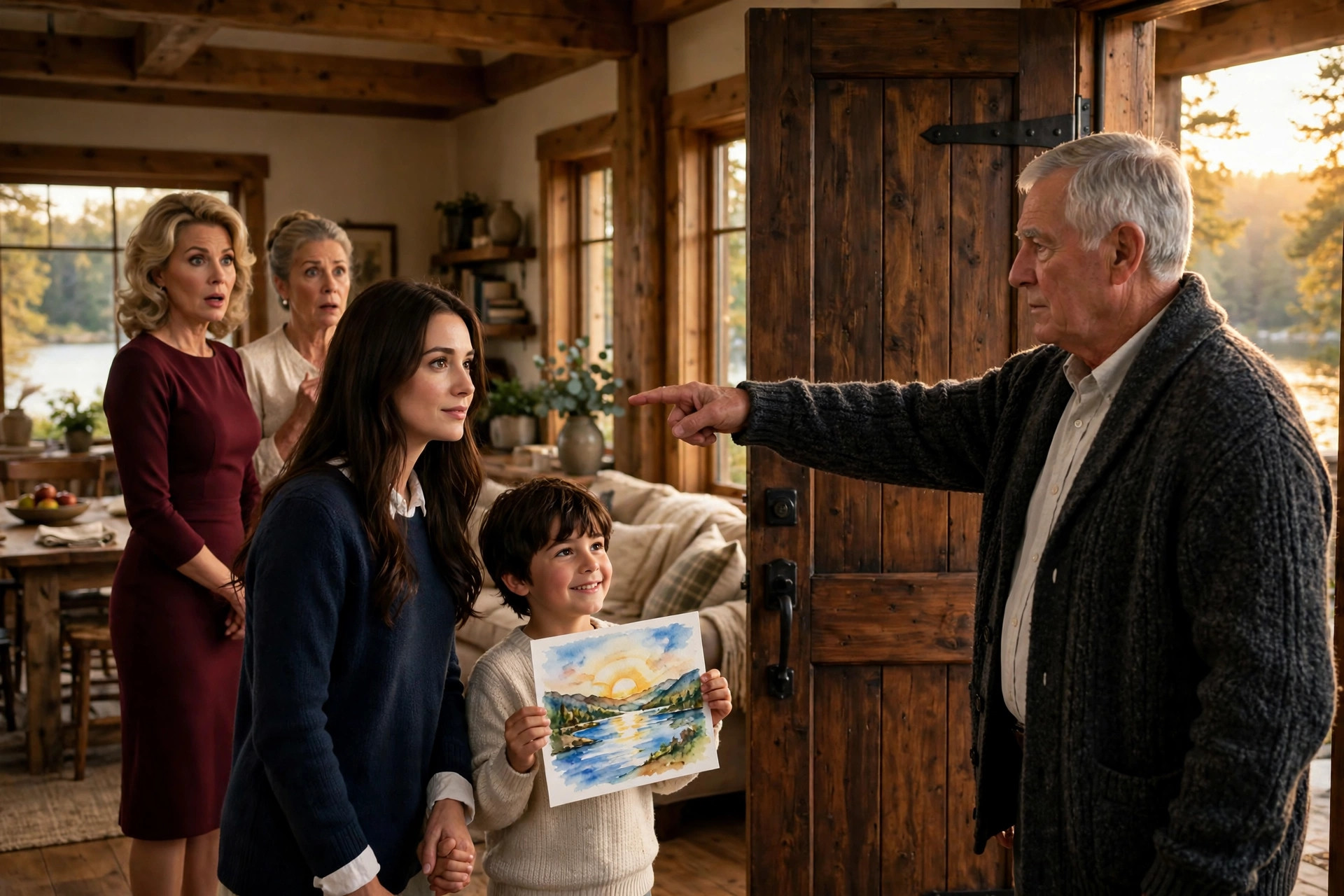
He pointed a steady, calloused finger directly toward the heavy front door.
“Get your things. Get in your car. And get off this land before I call the county sheriff to have you removed in handcuffs.”
---
All chapters
- Chapter 1 - The Ring in the Wine
- Chapter 2 - The Audit of Betrayal
- Chapter 3 - Nightfall and Fractured Glass
- Chapter 4 - The Skeletons in Susan’s Closet
- Chapter 5 - Packing the Poison Out
- Chapter 6 - The Legal Siege
- Chapter 7 - The Downfall of Jessica’s Empire
- Chapter 8 - The Truth About Clara’s Mother
- Chapter 9 - The Final Confrontation
- Chapter 10 - Two Lakes
Original source: Chapter 1 - The Ring in the Wine