
The brass knob gleamed under the hallway chandelier, catching the cold winter light filtering through the transom. When the tumbler clicked, the sound was unnervingly loud, like the cocking of a firearm in a quiet room.
Marlene stepped through the threshold. She was wearing the deep emerald velvet robe I had bought her for her thirty-fifth birthday. Her hair was pulled back into an effortless, photogenic bun, and her face was flushed with the artificial glow of holiday cheer. In her manicured hands, she held a large, rectangular box wrapped in silver foil paper and crowned with an elaborate royal blue ribbon. Stenciled in glittering gold marker across the tag was Ivy’s name.
"Merry Christmas, sleepyhead!" Marlene sang out, her voice pitched in that breezy, theatrical register she reserved for church socials and neighborhood block parties. "Look what Santa left behind the tree! I told the kids we couldn't bring it out until the big surprise was ready."
She froze mid-stride.
Her gaze dropped from my face to the two heavy duffel bags resting against the baseboard by the front door, then to Ivy, who was bundled in her heavy navy parka, fleece-lined boots, and knitted woolen hat. Ivy was standing half a step behind my left hip, her fingers clutching the pocket of my coat so tightly her knuckles were white. In her other hand, pressed flush against her ribs, was the small brown paper package tied with rough white kitchen twine.
The air in the foyer curdled. The smells of the house—cinnamon rolls baking in the oven, expensive pine-scented candles, and the buttery heat of hazelnut coffee—suddenly felt suffocating.
"Peter?" Marlene’s voice lost an octave of its music. Her eyes darted back to my face, scanning the dark hollows under my eyes, the set of my jaw, the stiffness of my spine. "You’re home early. I thought your shift ended at eight."
"My shift ended at seven," I said. My voice did not sound like my own. It had the flat, lethal neutrality I used in Trauma Bay 4 when a patient was bleeding out and panic would kill them faster than the wound. "I pulled into the driveway at seven-forty."
Marlene’s eyes twitched toward the living room doors. Behind her, through the open frame, I could see the wreckage of an opulent morning: ribbons shredded into heaps on the hardwood, mountains of torn glossy paper, empty plastic blister packs, a brand-new high-end tablet glowing on the coffee table beside an unopened stack of designer clothing. Coral and Forrest were seated on the carpet, their backs half-turned toward the hall. Forrest was frantically tapping at a handheld gaming console; Coral, twelve years old and too smart for her own good, had already stopped moving. She sat with her knees drawn up, looking over her shoulder with an expression of sharp, instinctive dread.
"Oh," Marlene said, letting out a breath that sounded like a dry laugh. She adjusted her grip on the silver package. "Well, you should have texted. We were trying to give you a moment to walk in on the grand finale. The kids were so excited, Peter. Forrest couldn't sleep past five-thirty, and you know how he gets. We had to do the Santa things first, or he would have torn the house down."
"Ivy came down at six," I said.
Marlene didn't blink, but the muscles around her mouth hardened. "Yes. And I told her to go back upstairs and rest."
"No," Ivy whispered. The sound was tiny, muffled by the wool of my jacket, but in the echoing hall, it sounded like thunder.
Marlene’s smile vanished completely, replaced by that thin, razor-sharp line of maternal condescension she always deployed when challenged. "Ivy, sweetheart, don't interrupt your father when he’s talking. Peter, she’s confused. She was half-asleep. I told her we were doing family time in shifts because you weren't home yet and we wanted her big moment to be special."
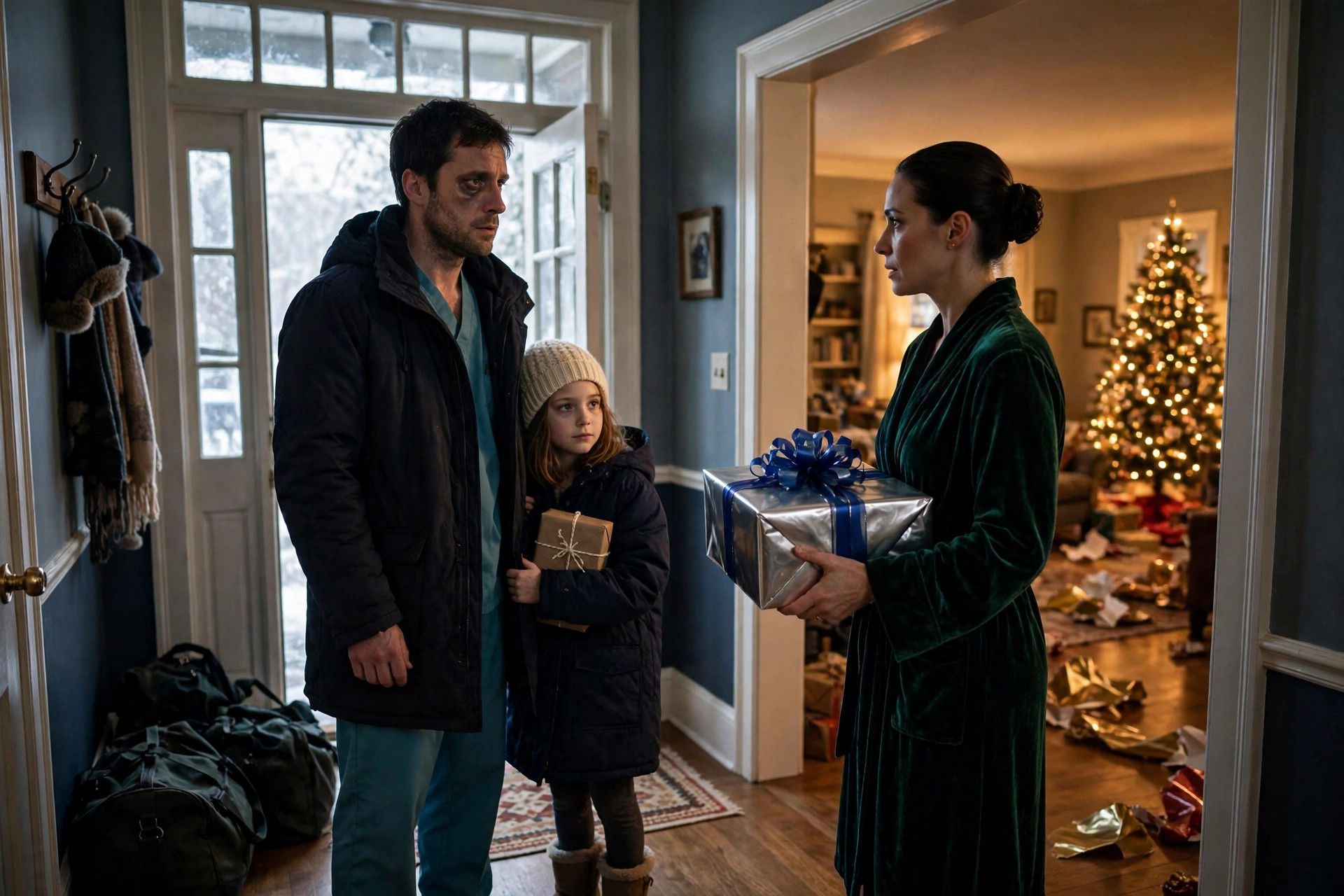
"You locked the doors, Marlene."
"I closed them so the dogs wouldn't track wrapping paper into the kitchen!"
"The dogs are at your mother's in Fort Collins," I replied. I took a step forward. I didn't raise my voice. I didn't shout. Shouting gives the other person something to push back against; it gives them an excuse to call you unstable. I kept my tone at that freezing, absolute zero. "And you didn't close them. You turned the brass key. You locked a ten-year-old child in an unheated hall for an hour and forty-three minutes while you fed your biological children cinnamon rolls and let them tear through hundreds of dollars of plastic."
Marlene’s skin mottled with red patches along her throat. She thrust the silver box toward me, as if using it as a shield. "I did not *lock* her out! It was an accident if the latch caught! Why are you doing this right now? On Christmas morning? In front of the children?"
From inside the living room, Forrest’s console chimed a cheerful 8-bit fanfare, completely oblivious. Coral, however, stood up. She let the discarded wrapping paper slide off her lap and stood near the doorway, her hands nervously picking at the hem of her oversized holiday sweater.
"Mom..." Coral muttered, her voice trembling. "You told her she couldn't come in until eight. You told her to wait on the stairs."
Marlene whirled around, her eyes flashing with a sudden, vicious panic. "Coral, go back to your brother. Right now."
"No, Coral, stay right there," I said, holding out a single hand. Coral looked at me, her eyes brimming with tears. She wasn't a bad kid. She was twelve, caught in the tractor beam of a mother who treated love like a finite currency to be hoarded and traded. "Did your mother tell Ivy she couldn't come in?"
"Peter, stop interrogating my daughter!" Marlene shrieked, dropping the silver box onto the hall runner. The impact made a hollow *thud*. "You do not get to come in here after an overnight shift, smelling like antiseptic and exhaustion, and play the righteous martyr! I manage this house! I have kept this family running while you play hero in the ER sixty hours a week! If I made a scheduling mistake on Christmas morning because I was trying to manage three over-stimulated kids, you don't get to treat me like a criminal!"
"A scheduling mistake?" I laughed, a short, ugly sound that startled even myself. "You told my motherless daughter that she should be grateful she has a bed to sleep in because some children don't have houses on Christmas."
Marlene stopped. The color drained from her cheeks, leaving behind a waxy, sickly gray. She glanced down at Ivy, whose small face was pressed firmly into my hip, refusing to look at her.
"I... that was context," Marlene stammered, the smooth facade finally splintering into jagged pieces. "She was whining, Peter. She was banging on the glass. Forrest was having a sensory overload from the noise. I told her that she needed to have perspective. It was a teaching moment about gratitude!"
"You taught her, all right," I said, bending down smoothly to pick up the two duffel bags with my right hand, keeping my left firmly wrapped around Ivy’s trembling fingers. "You taught her that in this house, she is a second-class citizen. You taught her that her grief is an inconvenience, her presence is tolerated, and her place is on the other side of a locked door."
"Where do you think you’re going?" Marlene moved to block the front door, her arms outstretched, her emerald robe billowing like the wings of a predatory bird. "Peter, put those bags down! It is Christmas Day! My parents are driving in from Fort Collins at noon! We have a prime rib in the refrigerator! You are not walking out of this house and making a scene!"
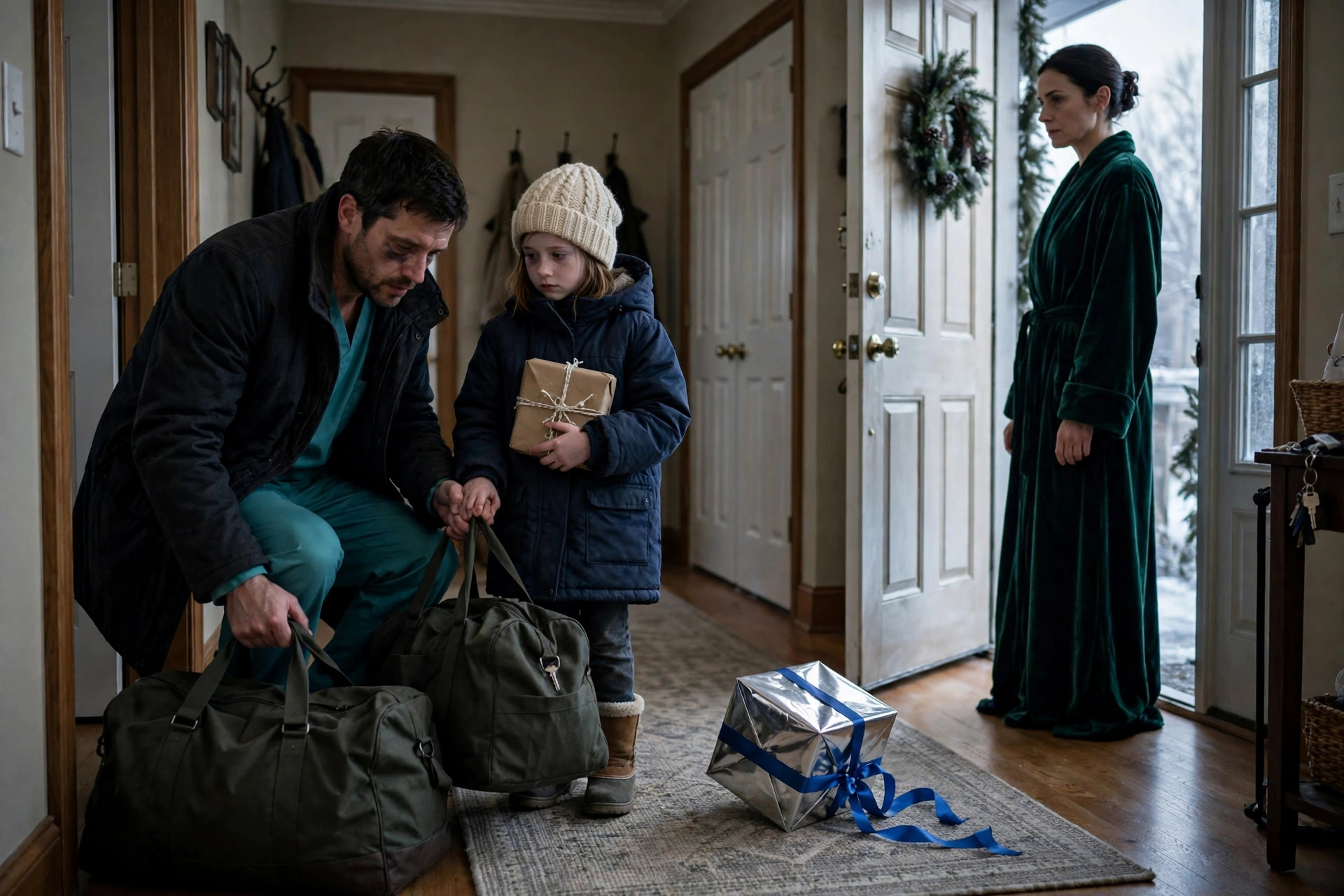
"The scene is already made, Marlene. You set the stage at six o'clock this morning."
"If you walk out that door, we are done!" she screamed, her voice hitting that shrill, piercing register that bounces off drywall. "Do you hear me? You walk out on your wife and your stepchildren on Christmas morning, and there is no coming back! I will tell everyone what you did! I will tell the hospital board! I will tell our neighbors that you had a psychotic break after a shift and abandoned your family!"
I looked at the woman I had married three years ago.
When Natalie died of metastatic breast cancer four years prior, I had been an empty shell walking through a gray world. Marlene had appeared in my life eighteen months later like a blast of primary colors—vibrant, decisive, organizing my chaotic pantry, bringing home-cooked meals to the hospital, telling me that Ivy needed a mother's touch and that blending our families would give Ivy the siblings she never had.
I had been so desperate to give my daughter a whole world again that I had ignored the subtle erosion of Ivy's space. The way Natalie’s photographs had slowly migrated from the living room mantel to the upstairs hallway, then into storage boxes in the basement. The way Ivy's bedroom was moved to the smaller room at the end of the hall so Forrest could have the corner room with two windows. The way Marlene always bought Coral the name-brand sneakers while finding Ivy's clothes on clearance racks, claiming Ivy "outgrew things too fast anyway."
I had told myself it was just the friction of blending. I had told myself I was being overly sensitive, hyper-vigilant, grieving.
I had been an idiot.
"I don't care who you call," I told her, my voice dropping into that terrifying calm that made Marlene step back half an inch. "I don't care what you tell the neighbors. But you will move away from that door right now, or I will call the sheriff's department from my cell phone, put it on speaker, and report that you are physically preventing a physician and a minor child from leaving the premises."
Marlene’s chest heaved. Her eyes were wide, glittering with a mixture of rage and genuine shock. She wasn't used to me pushing back. In our marriage, I had always been the peacemaker, the one who apologized for being tired, the one who smoothed things over to avoid a fight in front of the kids.
She slowly stepped to the side, her arms dropping to her sides.
"You're a coward," she hissed. "Running home to your mommy because you can't handle a real family."
I didn't answer her. I opened the heavy front door. The icy Colorado mountain air hit our faces like a slap of clean water, cutting through the stagnant warmth of the house. I guided Ivy out onto the porch.
"Dad?" Coral’s voice came from the threshold.
I turned back. The twelve-year-old was standing there in her socks on the cold wood, her face wet with tears. "Are you coming back?"
My heart tore slightly for her. Coral wasn't Marlene, but she was trapped in Marlene’s orbit.
"I don't know, Coral," I said honestly. "Have a Merry Christmas with your brother. Make sure he eats something besides candy."
I closed the door behind us.
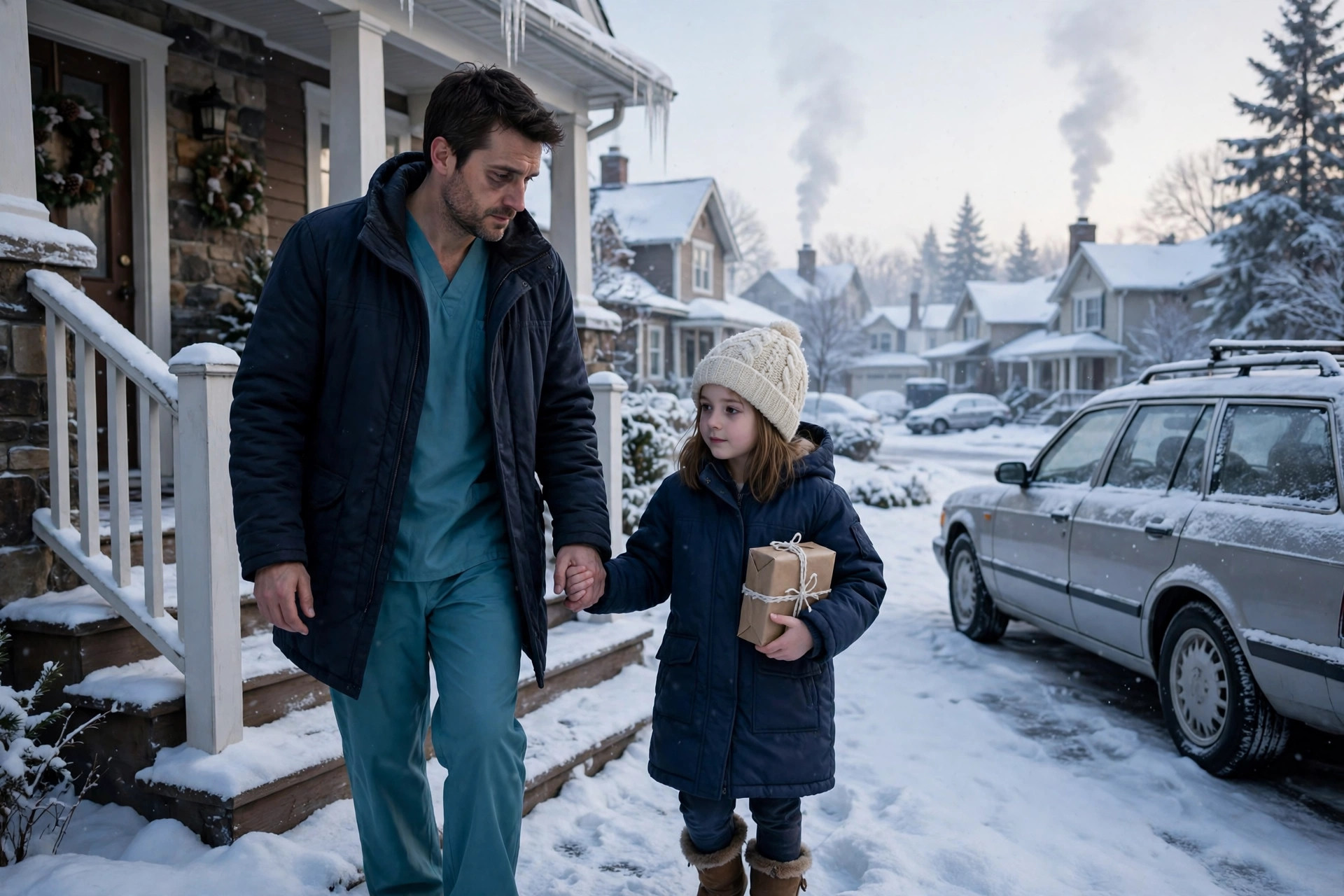
The silence of the morning descended instantly. The neighborhood was dead quiet; pristine, glittering snow blanketed the lawns, and smoke rose in gentle, straight pillars from the chimneys of our neighbors’ houses. It looked like a postcard of suburban bliss. It looked like a lie.
I walked Ivy down the front steps, holding her hand firmly so she wouldn't slip on the ice I hadn't had time to salt. I opened the passenger door of my Subaru Outback, lifted her into the seat, and buckled her in. She was so light. At ten years old, she should have felt heavier, more grounded, but she felt like a sparrow—fragile, hollow-boned, terrified of making a sound.
I tossed the duffel bags into the rear cargo area, right next to the large, flat box hidden beneath the yellow emergency blanket.
I slid behind the steering wheel, turned the key, and let the engine roar to life. The dashboard clock read 8:12 AM.
Beside me, Ivy sat with her hands clasped in her lap, her eyes fixed straight ahead through the frosted windshield. She still hadn't let go of the brown paper package.
"Ivy?" I said gently, shifting into reverse.
"Are we bad?" she asked. Her voice didn't shake. It was worse; it was resignated. "Did I ruin Christmas for Coral and Forrest?"
I backed out of the driveway, the tires crunching loudly over the crust of snow, and swung the car onto the street. As we passed our house, I saw Marlene standing in the living room picture window, the sheer curtains parted, her silhouette motionless and black against the glow of the Christmas tree lights.
"No, star," I said, reaching over with my right hand and covering her cold, small fingers. "You didn't ruin a single thing. You just helped me open my eyes."
---
All chapters
- Chapter 1 - The Threshold Confrontation
- Chapter 2 - The Warmth of a Real Family
- Chapter 3 - The Digital War & Marlene's Smear Campaign
- Chapter 4 - Uncovering the Hidden Trail
- Chapter 5 - Coral's Silent Guilt
- Chapter 6 - The Custody Battle & Legal Clashes
- Chapter 7 - The Revelation of Natalie's Legacy
- Chapter 8 - The Confrontation in Court
- Chapter 9 - Healing and Rebuilding
- Chapter 10 - The Cocoa on the Porch
- Chapter 11 - An Uninvited Shadow at the Gate
- Chapter 12 - The Poison in the Fine Print
- Chapter 13 - The Anatomy of a Shakedown
- Chapter 14 - The Viper Strikes at Dawn
- Chapter 15 - The Reckoning in Room 412
- Chapter 16 - The Jurisdiction Clash
- Chapter 17 - The Tapes of Blackmail
- Chapter 18 - The Desperate Ambush
- Chapter 19 - The Raid on Vance Manor
- Chapter 20 - The Midnight Summons
- Chapter 21 - The Ghost of Logan Airport
- Chapter 22 - The Midnight Injunction
- Chapter 23 - The Secrets in the Silver Locket
- Chapter 24 - The Paternity Ambush
- Chapter 25 - The Verdict of Blood and Honor
- Chapter 26 - The Shadow of Natalie’s Past
- Chapter 27 - The Ghost at the Hospital Gates
- Chapter 28 - The Foreclosed Sanctuary
- Chapter 29 - The Secret in the Dollhouse
- Chapter 30 - The Midnight Encroachment
Original source: Chapter 1 - The Threshold Confrontation