
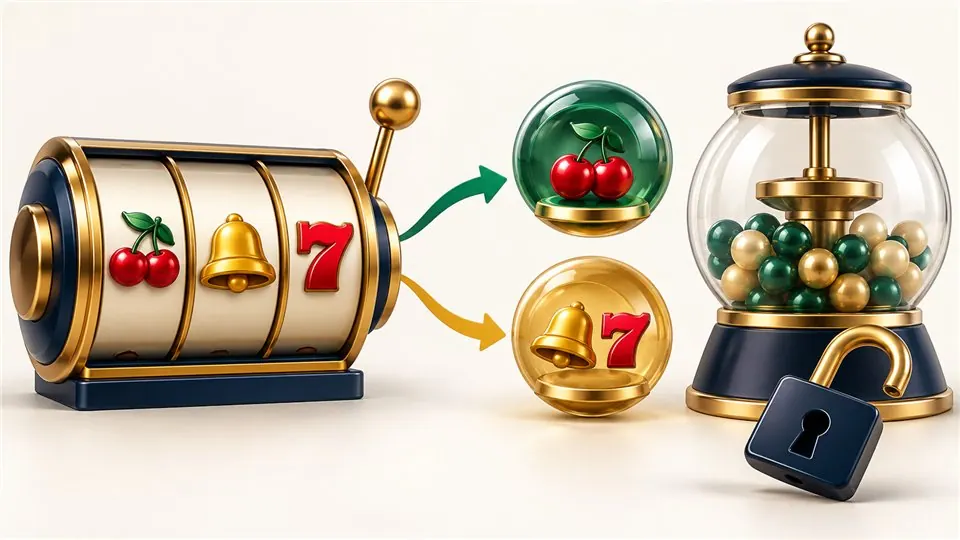
A large award followed by several misses can feel like the slot has decided to take the money back. That interpretation assumes an adaptive rule that the displayed sequence does not establish.
Ask what actually changed after the win: a progressive meter, a feature state, a selected mode or simply the player's balance. Those are different explanations.
An independent base model does not retaliate
Under an unchanged independent model, the previous award is not a reason for the next selection to become less favourable. In an invented model with a 2% event chance, receiving the event leaves the next ordinary round at 2%.
Loto-Québec's explanation distinguishes configured chances from the random result of a spin. That is an account of its machine context, not certification of every online launch.
A progressive reset changes an amount
After a jackpot award, its meter may return to a seed amount under the published rules. That changes the displayed potential prize. It does not by itself prove that the probability of triggering the next award changed.
Compare the actual eligibility and trigger rules before and after. Do not treat a lower meter as a loss of ordinary base-round RTP without the complete model.
Finishing a feature can return play to another rule state
A bonus with a growing multiplier can end and return to its ordinary base mode. The next round may therefore look less dramatic than the last feature round.
That is a stated transition between modes, not necessarily a hidden response to someone winning. Compare like with like: ordinary rounds against ordinary rounds, not the strongest bonus state against the base display.
Choosing the story after the event creates a trap
If you start counting only after a memorable award, the subsequent misses become a narrative about that award. Similar runs occurring elsewhere in the record may go unnoticed.
A real test needs a predeclared question, the full relevant sample and identification of the configuration. One selected sequence cannot distinguish adaptive control from ordinary variation.
A configuration difference needs its own evidence
Switching operator launches or optional modes can change what is loaded. If the stated configuration changes, document that directly rather than assigning the change to the earlier win.
If it does not change visibly, do not invent an invisible setting from the balance chart. Record the uncertainty and the specific evidence needed to resolve it.
Do not use either version of the myth to extend play
“It is tight now” and “it is due after these misses” can both create arbitrary rules for continuing or switching. Neither is a reliable prediction from the sequence alone.
Read the due-to-pay explanation and keep stopping decisions independent of the belief that the slot is now rewarding or punishing you.
Sources and review notes
Source-checked 2026-10-07. Regulatory references apply within their stated jurisdictions, not to every demo or country. Practical examples are explanatory, not provider certification or predictions of future results.
Continue reading

Can a Slot Be Due to Pay? Losing Streaks Are Not a Countdown
Understand why independent slot rounds do not become overdue, how long-run averages differ from compensation and which published states need separate analysis.

How Progressive Jackpots Grow: Contributions, Seeds and Resets
Follow a fictional progressive pool from its starting value through eligible contributions and a reset. Separate prize growth from trigger probability and demo displays.

Why a Short Slot Session Can Look Nothing Like Its RTP
Use a fictional rare-award model to understand sample variation, incomplete records and why a losing session does not need to correct itself.