
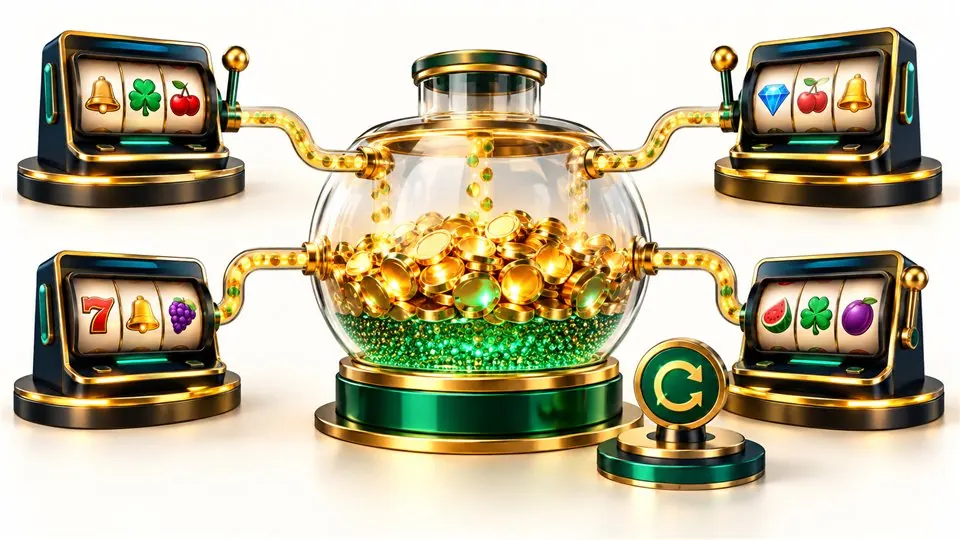
A progressive jackpot has an award value that can grow under its defined funding rules. A shared meter may receive eligible contributions from more than one participant, but the visible number does not explain the entire trigger, eligibility or payout process.
Read the pool rules as well as the slot paytable. They answer different parts of the question.
The starting seed is different from later contributions
A fictional pool might begin at 1,000 credit units supplied as its seed. Its rules might then add 0.01 units from each eligible 1-unit stake. After 200 such contributions, the displayed pool would be 1,002 units, assuming no other activity or adjustment.
That illustration defines its own contribution rate. It is not a universal percentage or a description of an actual demo. Real rules may have multiple pools, contribution rates, funding arrangements or reserve balances.
Contributing, qualifying and triggering are separate rules
Read whether the chosen stake and mode qualify, whether a separate entry is required and which event awards the prize. A prominent “Grand” label does not establish eligibility.
The British RTS 9 standard requires accessible jackpot rules and addresses funding, eligibility, ceilings and reset information within its scope. It does not supply one trigger probability applicable to all providers.
What happens after an award or at a ceiling
A pool can reset to its defined seed after a qualifying award. That is not necessarily zero, and it need not equal the value first shown when you arrived. The rules should explain how the new starting value is funded.
If the pool has a ceiling, find out where subsequent eligible contributions go. A reserve or overflow arrangement can exist under stated rules. Do not assume that a capped display means all subsequent contributions disappear or that the next round must award it.
Growth in value is not automatically growth in your chance
The amount and the trigger mechanism are separate aspects of the model. A constant-probability design and a state-dependent design require different analysis. You cannot identify the correct model from the meter alone.
Our jackpot probability guide explains why an average waiting interval is not a deadline. A larger pot can still be rare, and a history of previous losses does not itself establish eligibility or imminent success.
A demo jackpot is still a non-redeemable demonstration
Check whether the demo describes a live pool, a simulated meter or a fixed practice value. If that information is absent, mark it unconfirmed. A displayed jackpot award in practice credits is not evidence that the player won money from a real shared pool.
For a useful note, record the title, version, pool description, eligibility statement and what you actually observed. Keep a provider explanation separate from a screen recording, and keep both separate from a paid operator's account terms.
Sources and review notes
Source-checked 2026-10-07. The seed and contribution example is fictional. A demo illustration does not establish connection to a live jackpot pool.
Continue reading

Slot Jackpot Probability: Rare Does Not Mean Overdue
Distinguish jackpot value, eligibility and event probability. A fictional calculation explains average waiting times without promising a win after enough spins.
Progressive Jackpot History: From a Local Prize to a Networked Pool
Trace the significance of IGT’s 1986 Megabucks system, distinguish local and wide-area networks and understand why historic award terms matter.

Slot Maximum Wins and Caps: Read the Limit Behind the Headline
Distinguish a maximum multiplier, a round cap, a progressive prize and promotional cashout terms. Calculate a fictional cap using the correct stake unit.
Slot Demos vs Real-Money Slots: What Actually Changes?
Compare demo credits, slot rules, RTP settings and player protections. Understand which parts of free play can inform a review and which cannot.