
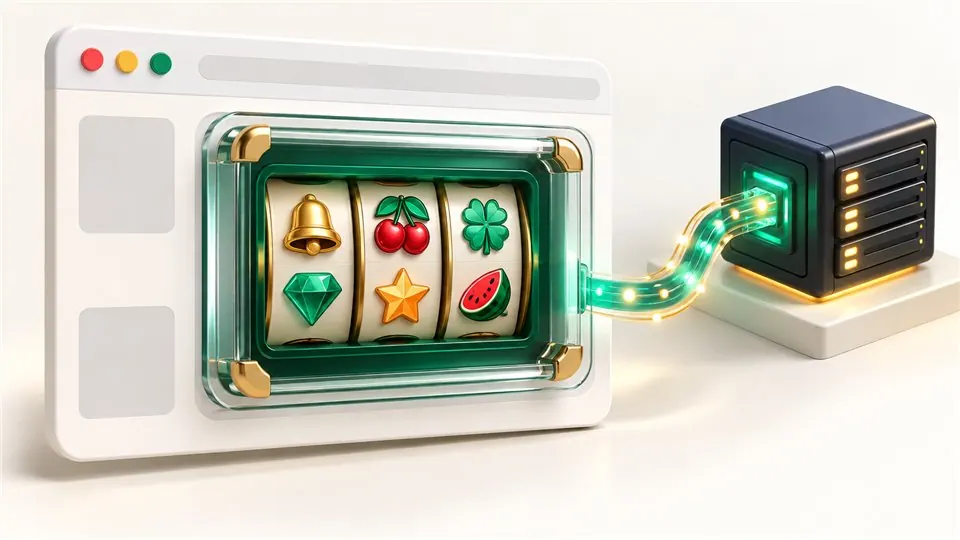
A slot demo iframe not loading can involve a wrong launcher, the provider’s embedding policy, browser storage or a regional response. An iframe displays another origin; it does not transfer ownership of the player or override its security rules. Identify the exact failing step before changing the integration.
Two documents share one visible page
The surrounding article, poster and Close button belong to Lupita. After Play is pressed, the iframe loads the remote slot document. As MDN explains, the frame creates a nested browsing context.
Keeping the visitor on the same page is therefore compatible with remote hosting. A provider player is not downloaded into Lupita’s catalogue simply because it appears inside the layout.
A launch URL is not necessarily an open API
A public demo link may include a product identifier, language, mode or session information. That address can be designed for demonstration without granting a third party contractual distribution rights.
Do not treat a URL copied from a supplier’s site as permission to sell the demo, collect deposits or remove supplier notices. Commercial embedding rights and the technical ability to display a frame are separate matters.
The remote service decides whether framing is allowed
A provider can use CSP frame-ancestors to identify allowed embedding parents. The older X-Frame-Options header can also prevent framing.
Adding fullscreen permission on Lupita does not override those headers. A player that works on the provider’s own page may still be refused inside another site. Stripping or proxying away security policies is not a legitimate fix for a denied integration.
Permissions are deliberately limited
Lupita’s player permits the scripts needed by its remote demos while withholding popup and top-page navigation permissions. The intention is to retain the surrounding page and provide an explicit Close control.
That sandbox is not a guarantee that the embedded service collects no data, nor a substitute for reviewing supplier privacy information. Permission changes should be made for a documented need, not by granting every browser capability until something loads.
A load event is weaker evidence than it sounds
Browsers can fire an iframe’s load event even when its content fails to load. MDN documents this behavior as a security precaution. A cleared loading label therefore cannot prove that the slot reached a usable screen.
The real check is visible and interactive: does the intro appear, can the paytable open, and can a free round complete? Lupita’s link audit cannot answer those questions by itself.
Describe the stage of failure
A blank frame, an explicit territory message and an intro that freezes after Play are different symptoms. Record the page, browser, device and stage, while avoiding session tokens or private account data.
Reloading may help an expired session but cannot grant permission the service denies. When the source will not support the integration, marking the demo unavailable is more accurate than presenting a broken player as playable.
Sources and review notes
Editorially reviewed 2026-10-08. Regulatory references apply within their stated jurisdictions, not to every demo or country. Practical examples are explanatory, not provider certification or predictions of future results.
Continue reading

Lupita Slot Demo Checks: What Link and Player Tests Establish
Follow the source-to-player checks behind Lupita’s catalogue, including why an HTTP response is not a mobile play test or a mathematical certification.

Slot Demo Unavailable by Country: Separate Region and Network Errors
Separate territory restrictions from expired sessions, browser blocking and network errors before deciding why a free slot demo is unavailable.

Slot Studio vs Aggregator: Identify Who Makes and Delivers It
Trace the roles of developer, publisher, aggregation service and operator so a launcher domain is not mistaken for the slot’s creator.