

The applause began the way applause always begins at Franklin Military Academy: all at once, like rain arriving on a tin roof. Audrey Vance stood in the courtyard in her formal uniform beneath her open graduation gown, twenty-two years old, her brown hair pulled into a regulation bun, her brown eyes fixed on the rows of families in the bright Virginia daylight. Four years of early mornings, of mud and examinations and orders obeyed without complaint, had narrowed to this single afternoon near Charlottesville — and for three whole seconds, it was hers.
Then her father, Arthur Vance, stepped out of the crowd.
This is a work of fiction, adapted from a Lupita video prompt about Arthur Vance, Audrey Vance and Victoria Vance. The academy, the graduation and the folder at the centre of this chapter are invented. What follows is Chapter 1 of The Sealed Folder.
The Applause Stops
Audrey heard the applause before she saw her father. It rose from the families seated in white folding chairs, from her classmates standing in formation, from the stone walls of the courtyard itself, and for a moment she allowed herself to believe it. She had earned this. Nobody in her family had ever said so out loud, but the diploma in the dean's hands, the ribbon on her chest, the small blemish beside her jaw that no amount of regulation could hide — all of it was real, and all of it was hers.
Arthur Vance was early fifties, thinning brown-and-gray hair, a square face lined with forehead creases, a charcoal suit that had cost more than Audrey's first car. He did not clap. He walked toward her through the gap between the chairs with the slow, deliberate stride of a man who had rehearsed this moment in his head a hundred times and had never once imagined himself wrong.
The slap came without warning. Arthur swung his open hand, and the sound of it — sharp, flat, unmistakable — cut through the applause and killed it. Audrey recoiled with a scraping step, her graduation cap slipping from her head and landing on the stone with a dull tap. The courtyard, which a second earlier had been full of music and voices, went silent. Two hundred people held their breath at the same time.
Arthur looked at his daughter, at the red mark blooming on her cheek, at the uniform he had never once praised, and he shouted so that every row could hear him: "You never earned this!"
Victoria's Verdict
Victoria Vance arrived beside her husband on clicking heels, as if she had been waiting just behind him for her cue. She was approximately fifty, chestnut hair arranged with care, fine lines at the corners of her eyes, pearl earrings catching the light, a cream dress that belonged at a garden party rather than a military graduation. She looked at Audrey — really looked at her, at the reddening cheek, at the tears her daughter was refusing to shed — and then she looked past all of it, to the uniform.
Victoria gestured at the uniform with contempt, her bracelet rattling against her wrist, and her voice carried the same practiced cruelty as her husband's, only colder. "You're a failure in uniform," she told Audrey sharply, and the words landed harder than the slap, because they had been rehearsed for years. Audrey had heard some version of them at every dinner table, in every car ride home from school, in every silence that followed every report card she had ever brought home with pride.
Audrey's eyes filled with wounded disbelief. She did not cry. She had learned, at some point she could no longer name, that tears in front of her parents were only ever treated as evidence. Evidence of weakness. Evidence that they had been right all along. So she stood in the courtyard in her gown, her cap on the stone at her feet, and she let the silence do what it wanted with her — and waited for her own voice to come back to her.
"You Hit Me. Everyone Saw."
Audrey steadied her feet. The gritty scrape of her shoe on the stone was the only sound in the courtyard. She raised her face toward Arthur, and her breathing caught once, briefly, the way a swimmer's does before going under — and then it did not catch again. Something in her chest, something that had been folded small and quiet for twenty-two years, unfolded all at once.
"You hit me," Audrey said. Her voice was not loud at first. It did not need to be. Two hundred people were listening now, and every one of them heard her. "Everyone saw."
Arthur's jaw tightened. He had expected tears, or silence, or the old Audrey — the girl who apologized for things she had not done, who made herself smaller so that her parents could feel larger. Instead his daughter was standing in front of him, her cheek still burning, her eyes clear, and she was telling the truth out loud in a place where the truth had never been allowed to live. Victoria shifted beside him, her fingers closing around her pearl earring, and for the first time that afternoon, Audrey saw something unfamiliar cross her mother's face. It was not regret. It was fear — small, quick, and immediately hidden.
Audrey did not retaliate. She did not raise her own hand. She simply stood her ground in her uniform, in front of everyone she had ever wanted to be proud of her, and waited to see what her father would do next, now that the whole courtyard was watching.
Stay Away from That Microphone
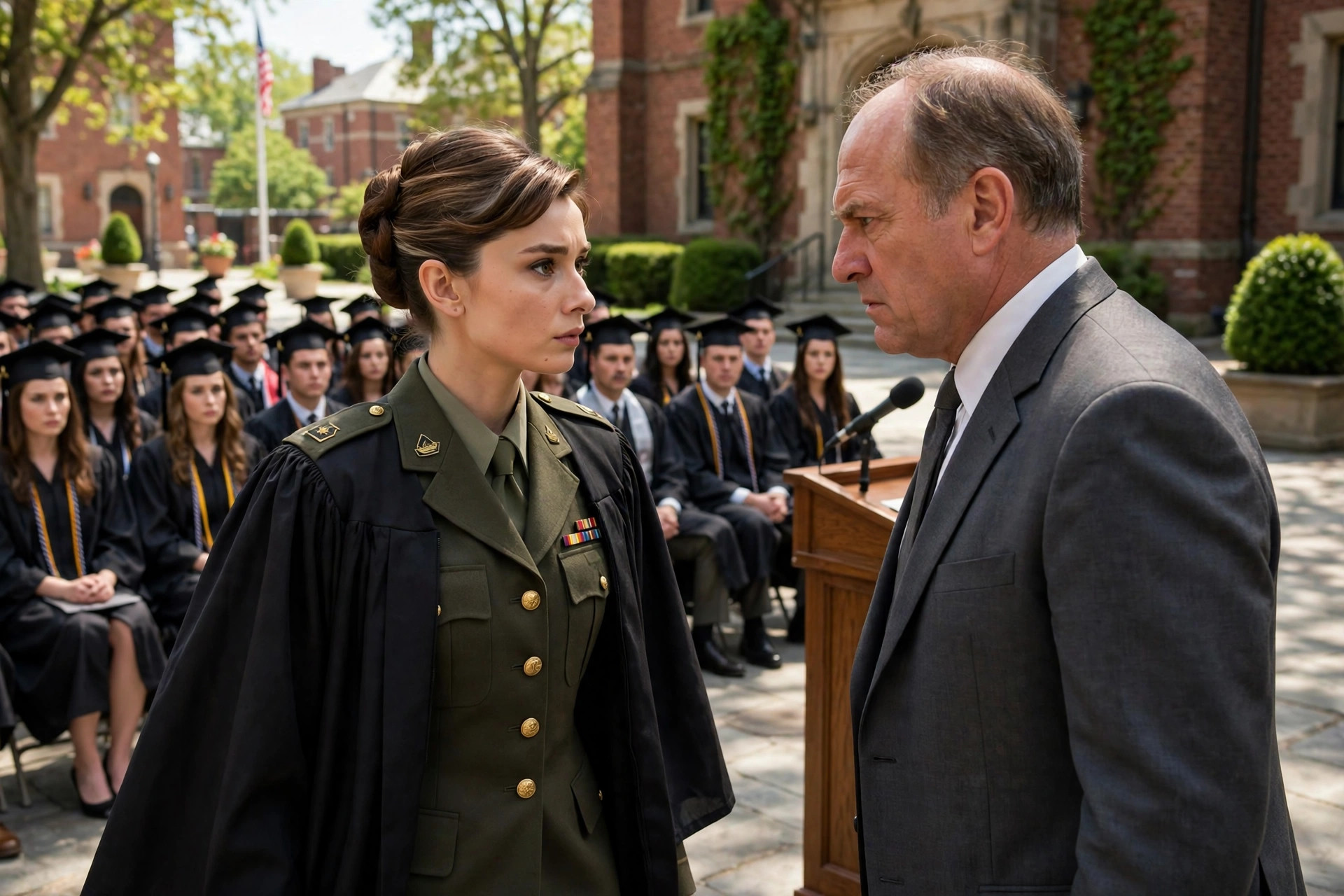
Audrey turned toward the podium. Her gown rustled as she moved, and the sound of it seemed to wake Arthur from whatever shock had held him still. He stepped into her path at once, his heel striking the stone hard, crowding her until she had to stop. The microphone stood only a few feet away, waiting on its stand, and Arthur planted himself between his daughter and it as if the thin metal pole were a door he could lock.
"Stay away from that microphone!" Arthur barked at Audrey, and his voice, which had been so certain a moment ago, had an edge in it now — a roughness, a hurry. He was no longer performing for the crowd. He was trying to stop something, and everyone in the courtyard could see it, even if nobody yet knew what it was.
Audrey held her ground without retaliating. She looked at the microphone, and then she looked at her father, and she understood, in the clear and terrible way that understanding sometimes arrives, that Arthur was not afraid of what she might say about the slap. A slap could be explained away. A slap could be called discipline, or a misunderstanding, or a father's grief. Arthur was afraid of something else entirely — something that had nothing to do with his hand, and everything to do with what Audrey was carrying beneath her gown.
The Folder with the Red Seal

Audrey reached beneath her gown and withdrew a thick manila folder. The dry rustle of paper in the silent courtyard sounded louder than the slap had. The folder was plain, unremarkable, the kind of folder that lives in filing cabinets and desk drawers — except for one thing. Its flap was closed with an intact red wax seal, deep and glossy in the daylight, and the moment it became visible, Victoria's breath caught in her throat.
Victoria's hand shot out toward the folder, her fingers reaching, her bracelet sliding down her wrist — and then her hand stopped short, frozen in the air, because Audrey kept the folder beyond her grasp. Her mother, who had never once hesitated in Audrey's memory, was hesitating now, her hand hanging empty between them.
"Put that folder away!" Victoria ordered Audrey urgently, and the urgency betrayed her. It was not the voice of a mother protecting a daughter. It was the voice of a woman protecting a secret. Audrey looked at the red wax seal, at her mother's outstretched hand, at her father's face, and she understood that whatever was inside that folder, her parents had spent years — perhaps her whole life — making sure she would never see it.
She held the folder against her uniform, and the paper creaked softly against the fabric. Her trembling fingers settled. The folder was hers. It had always been hers, even if she had only just found it. And she was not going to put it away.
Why Are You Afraid of This?
Audrey met Arthur's eyes. His blocking arm, which had been raised between her and the microphone, slowly lowered with a rustle of his jacket, and the contempt on his face gave way to something else — alarm, naked and undisguised. For the first time in Audrey's life, her father looked afraid of her. Not angry. Not disappointed. Afraid.
Audrey asked him loudly and clearly, so that every person in the courtyard could hear the question and carry it home with them: "Why are you afraid of this?"
Arthur inhaled — a strained, ragged breath, the breath of a man about to answer a question he has spent years avoiding — and he did not answer. The folder stayed unopened in Audrey's hands. Its contents stayed concealed. The applause did not return. The sun kept shining on the stone courtyard of Franklin Military Academy, on the cap lying where it had fallen, on the red wax seal that had not yet been broken, and on a daughter who had finally, in front of everyone, stopped asking for permission to speak.
Chapter 1 ends here. The folder is still sealed. What is inside it — and what Arthur and Victoria Vance have been hiding for twenty-two years — is a story for Chapter 2.
Sources and review notes
Source-checked 2026-11-13. Regulatory references apply within their stated jurisdictions, not to every demo or country. Practical examples are explanatory, not provider certification or predictions of future results.
Continue reading

After a Large Slot Jackpot: Verification, Payment Terms, Tax and Privacy
Understand the questions a headline leaves out: settlement basis, documentation, jurisdiction-specific tax and consent to publicity. A demo award cannot be claimed.

Slot Urban Legends: Lucky Hours, Hot Machines and the Magic Button
Examine recurring slot stories by identifying the claim, its hidden assumption and the evidence missing from a memorable winning anecdote.

Large Online Slot Wins: Guinness Recognition Versus Provider Announcements
Compare the 2013 and 2015 public Guinness history with Games Global’s reported 2023 WowPot award, preserving currency basis and verification limits.

Winning a Slot Jackpot Twice: The Documented Case and the Missing Denominator
Examine Elmer Sherwin’s reported repeat Megabucks awards and understand why two wins do not establish a strategy, population-wide odds or lifetime profit.