
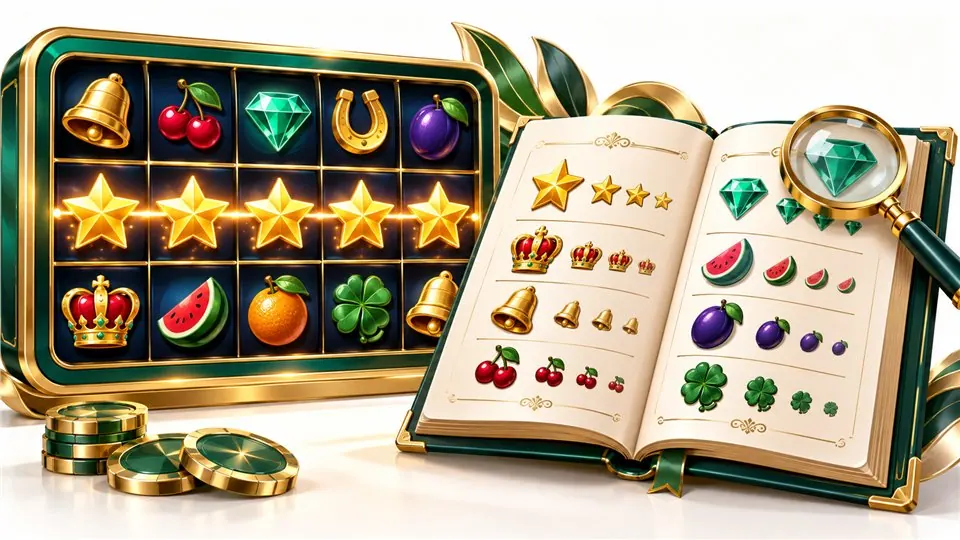
A paytable explains how a slot turns a displayed result into an award. Its symbol chart is only one part of that explanation. The stake unit, matching rules, Wild exceptions and bonus conditions can be just as important as the largest number on the screen.
Before a demo spin, aim to answer one question: Could I explain why this result paid this amount? The examples below show how to do that. All numerical examples are fictional illustrations using demo credits, not payout claims for a particular slot.
Where to find the paytable in a slot demo
Open a slot from the demo library, launch its player and look for an information icon, question mark, menu or Help label. The paytable may occupy several screens: symbol awards on one, feature rules on another and technical information further down. Check each page rather than stopping at the first symbol chart.
Record the exact title and the selected stake. If the menu shows a version or configuration, record that too. The provider's public product page is a useful source, but it may describe more than one configuration; the loaded demo's rules are the immediate reference for interpreting its displayed awards.
Readable rules and payout information are the purpose of the Gambling Commission's RTS 3 requirements in their British regulatory scope. Treat a missing or unclear rule as missing information, not as permission to guess it.
First, identify what the payout number multiplies
A figure such as 40× is incomplete until you know its unit. It could multiply the total stake for the round, a stake assigned to one line or another explicitly defined value. A paytable may also show credit amounts that update when the stake changes.
| Paytable wording | What to identify | Illustrative calculation |
|---|---|---|
| 40× total stake | The cost of the complete round. | 1 credit × 40 = 40 credits. |
| 40× line stake | The stake assigned to the qualifying line. | 0.05 credits × 40 = 2 credits. |
| Award shown in credits | Whether the chart already reflects the selected stake. | A displayed 2-credit award may already be the final value. |
These are three possible presentations, not a rule that every slot offers all three. In particular, a paytable value that has already been converted into credits should not be multiplied by the total stake a second time.
If you change the demo stake, reopen or recheck the chart. Ask whether the displayed numbers changed and whether the total round cost changed in the same proportion. A visually bigger award at a larger stake does not, by itself, establish better odds.
A worked example: a line win is not a total-stake win
Imagine a fictional slot with 20 active lines, an equal stake on each line and a total cost of 1 demo credit per round. Each line therefore carries 0.05 credits. Its rules say that four matching stars on one qualifying line pay 40 times that line stake.
The award for that one line is 40 × 0.05 = 2 demo credits. It is not 40 credits. If that is the only award in the round, subtracting the 1-credit round cost gives a net balance increase of 1 credit.
If a second line also qualifies, do not assume how the two awards combine. Check whether line wins are added, whether only the highest match pays on a line and whether there are restrictions on overlapping awards. Our hypothetical calculation assumes one qualifying line; those additional rules need their own explanation.
Also inspect the line diagram. Symbols that look adjacent may not occupy the positions of an active payline. A common left-to-right rule requires a match starting on the leftmost reel, but this is not universal: use the direction and starting-reel rule shown in the exact paytable. See paylines explained for the layout distinction.
Ways and clusters use a different matching test
Ways to win
In a ways system, the question is usually how many eligible matching symbols occur on successive required reels, not which drawn line they follow. Suppose a fictional rule requires three consecutive reels from the left. Two matching moons on the first reel, three on the second and one on the third can form 2 × 3 × 1 = 6 qualifying three-reel combinations.
That combination count is not an award of six credits. You still need the paytable's award per qualifying way and its stake basis. You must also check how longer matches and Wild substitutions are counted. A headline such as “thousands of ways” describes possible evaluation routes, not a guarantee that a round contains a winning one. Compare this with the ways-to-win explanation.
Cluster pays
A cluster system instead asks whether the required number of matching symbols connects under its stated adjacency rule. Check whether horizontal and vertical neighbours count, whether diagonal connections count and what the minimum cluster size is. Five identical symbols scattered across a grid may not form a qualifying connected group.
If the slot then removes winning symbols and drops new ones, read the cascade rules separately. They determine whether the new result is evaluated again and how any multiplier carries or resets. Do not import line-stake arithmetic into a cluster-pay slot unless its own rules specifically require it.
Read the exceptions for Wilds and Scatters
Wild does not automatically mean “replaces everything everywhere.” A Wild may be limited to particular reels, excluded from replacing a Scatter or jackpot symbol, or behave differently during a bonus. Expanding, sticky and moving Wilds also need an explanation of when they activate and when they disappear.
Scatter is another label to inspect rather than assume. Read whether the symbol pays an award, starts a feature or does both. Then check the required count, eligible positions and any change in the number of awarded Free Spins. A symbol's large artwork does not make it eligible for every kind of payout.
A real example makes the exception clear. BGaming's Fruit Million X-mas description says its Wild appears on reels 2, 3 and 4 and excludes the Bell and Diamond Scatters from substitution. That is a rule for this title, not for every BGaming slot. On the Fruit Million X-mas demo page, compare those statements with the rules in the loaded player.
Treat a bonus round as its own rule set
A base-round paytable may not explain the complete bonus. Read the feature instructions in the order the feature occurs:
- Entry: what exact symbol count, event or collected state starts it?
- Starting conditions: how many spins or respins begin the round, and what initial modifiers apply?
- Changes during play: can spins retrigger, can values grow, and what causes any counter to reset?
- Award calculation: which amounts are added, which are multiplied, and when does that calculation occur?
- End conditions: what ends the feature, and can an overall award cap end it earlier?
For example, “a multiplier increases during Free Spins” leaves several important questions unanswered: does it increase after every spin or only after a specified event, does it apply to all awards, and does it reset on the next feature? The answers can materially change how you interpret an animation.
If the interface offers a Bonus Buy, check its demo-credit cost and the rules of the purchased feature separately. A price shown as 100× the current total stake would cost 100 demo credits at a 1-credit stake in that fictional example. The price is not a promise of a 100-credit award, and an ordinary symbol-triggered feature need not have identical entry conditions.
RTP and maximum win answer different questions
The symbol chart tells you the award for a qualifying result. RTP describes a theoretical aggregate return for a defined model. Neither the highest symbol value nor the advertised maximum win tells you how likely that outcome is.
A maximum expressed as a multiple of total stake also needs its definition. If a fictional slot has a 5,000× round cap and the stake is 0.20 credits, that cap corresponds to 1,000 credits for that stake. Check whether the rules apply it to the entire round, a feature or something else, and whether reaching it terminates remaining spins.
Published information can even contain an inconsistency. When reviewed on 7 October 2026, the Fruit Million X-mas provider page used 97.1% in its descriptive text but 97.34% in its details. That discrepancy is a reason to check the loaded version and seek clarification, not to average the figures or silently select the larger one. It does not establish the RTP of an unrelated operator's configuration.
Do not attempt to settle an RTP question by playing until your demo balance resembles a percentage. The Gambling Commission's monitoring explanation distinguishes the theoretical model from observed results and their statistical variation.
A final check before you press Spin
You do not need to memorise the whole rulebook. You should be able to point to the information that answers these questions:
- What is the total demo-credit cost of this round?
- What must match, where must it match and how many symbols are required?
- Is the displayed award already in credits or a multiplier of a stated stake unit?
- Which symbols can a Wild replace, and what exceptions apply?
- What triggers a bonus, what changes within it and what ends it?
- Where are the version's RTP information and any award caps?
If the demo hides an essential answer, write down exactly what is missing. You can compare another slot instead of treating unclear rules as an invitation to keep spinning. Our free-play checklist shows how to turn these answers into a focused interface and feature check.
Common paytable questions
Why did a displayed 40× symbol award pay only 2 credits?
It may have used a line stake rather than the total round stake. It may also have involved a different qualifying symbol count. Check both the unit and the result; our worked example shows one possible explanation, not a diagnosis of every slot.
Do all matching symbols on the screen pay?
No. They must satisfy the slot's matching, position and minimum-count rules. A left-to-right line, a ways combination and a connected cluster are not the same test.
Does a large maximum win mean better chances?
No. A ceiling describes the largest allowed award under stated conditions, not its probability or the expected result of your session.
Are the demo rules necessarily the same everywhere?
Do not assume that. Check the exact version, market and configuration. A product-page summary is useful context, but it is not proof that every deployment uses the same settings.
Sources and review notes
Source-checked 2026-10-07. Regulatory references apply within their stated jurisdictions, not to every demo or country. Practical examples are explanatory, not provider certification or predictions of future results.
Explore the slot and related demos
Catalogue pages with provider sources and available embedded demos. Related titles share catalogue mechanics or themes; this is not a payout ranking.


Continue reading

How to Test a Slot Demo: A Practical Free-Play Checklist
Try a slot demo with a clear checklist for its paytable, bonus features and mobile controls. Learn what free play can show—and what it cannot prove.
Reels, Rows and Paylines: How to Read a Slot Layout
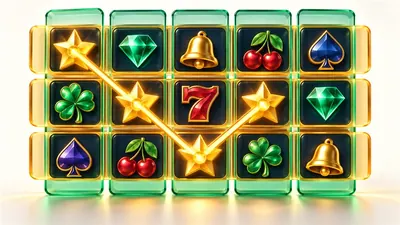
Read the difference between a slot grid and its winning paths. A worked five-reel example explains why matching symbols need the right positions.

Ways to Win Explained: Counting Matches, Not Drawing Lines
Work through a fictional ways calculation and distinguish possible routes from winning combinations, award units and variable-reel layouts.

Slot Maximum Wins and Caps: Read the Limit Behind the Headline
Distinguish a maximum multiplier, a round cap, a progressive prize and promotional cashout terms. Calculate a fictional cap using the correct stake unit.